Blog

Books that Bridge

Dance Joy

Until recently I have only opened one book at a time. Well, when I was in college I suffered through several texts at once. Then there was a long stretch of my life when I enjoyed a novel interspersed with a chapter or two of non-fiction. Now, with no kids, animals or visitors in the house, I have the luxury of reading several books at a time. I’m still working full-time though so I find myself only finishing a couple per month. I fantasize mightily about when I retire, and hop on a train with a stack of the print companions—no e-reader for me, thank you—while I travel across the country and back. Sounds like bliss.

For professional development this year I’m focused on Race and Equity. The material is definitely evocative; that’s an understatement. I’m glad that part of the HR requirement is to assemble a small group of colleagues to read together, discuss and apply our learning. We started with Between the World and Me by Ta-Nehisi Coates. So far in 2017, I’ve finished The New Jim Crow: Mass Incarceration in the Age of Colorblindness by Michelle Alexander and Hunger of Memory, The Education of Richard Rodriguez, An Autobiography. Waterlily, a novel about the Dakota people by Ella Cara Deloria and Negroland, the new memoir by Margo Jefferson are on my nightstand now, both half-digested.

I’ve also read several books of The Hebrew Bible as part of Education for Ministry (EfM), Year One. EfM is a four-year course developed by University of the South School of Theology in Sewanee,Tennessee. Each week I meet with 11 others to discuss these ancient scriptures and the commentary. I find myself more and more fond of my co-readers half of whom are men and half women; half younger/half older; some gay some straight; and one native Spanish speaker. I think we’d all call ourselves Christians but I’m not sure about that. We Episcopalians welcome diversity of all kinds, including differing beliefs so this hasn’t been an issue. As my son said about another group at the cathedral, “This is the most diverse group of white people I’ve ever met.”

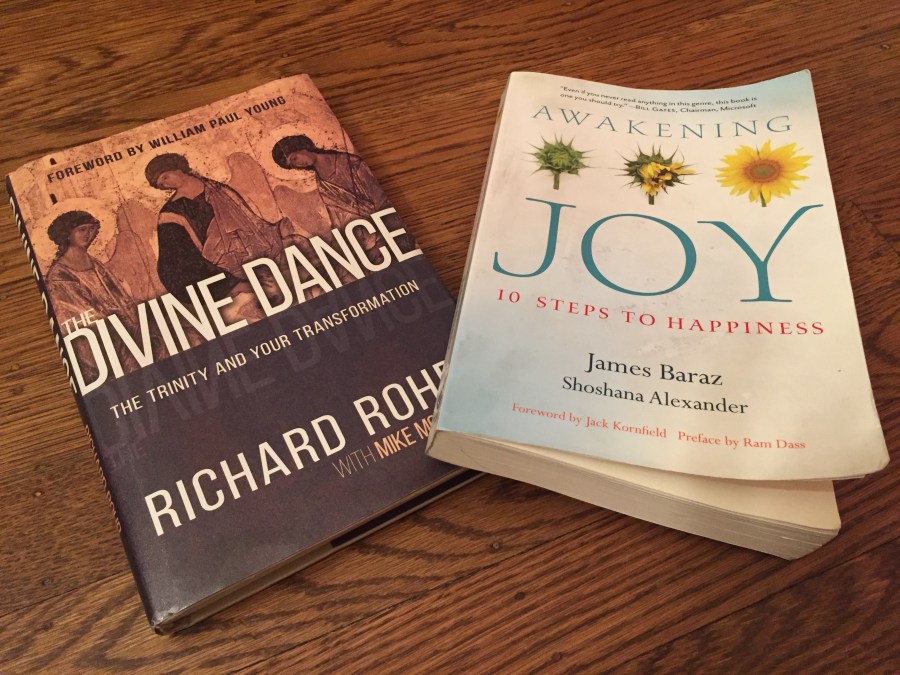
But the best current combination of books has been my morning practice jewels: The Divine Dance, The Trinity and Your Transformation by Richard Rohr and Mike Morrell and Awakening Joy, 10 Steps to Happiness by James Baraz and Shoshona Alexander. Most mornings for the past ten weeks I’ve read several sections of each book. Dance was an easy choice because I really appreciate Franciscan Rohr’s perspective on theology. This is his latest about the pervasive relationship of Trinity. My friend Jeanne introduced me to Joy, a Buddhist guide to becoming deeply content and embracing well-being. Both books are laced with real life stories. Both reference literature as well as spiritual leaders from around the globe and across time. With its frequent footnotes, Dance is slightly more academic and theoretical while Joy offers practical how-to advice.

Remarkably, as I absorb these works simultaneously I find no more room for the religion compartments I’ve heretofore established in my mind. When I think back, I can’t remember which pearl of wisdom came from which book. The overall philosophies of Dance and Joy are that similar. James Finley said it this way, “When we seek what is truest in our own tradition we discover we are one with those who seek what is truest in their tradition.” Nurturing these blossoms in the rich fomenting soil of my equity and scripture readings takes me right over the top—practically orgasmic. I can hardly describe it in words but I know this is what I was born for and what I will die for eventually.
 

Huesos as Living Prayers

mr-body

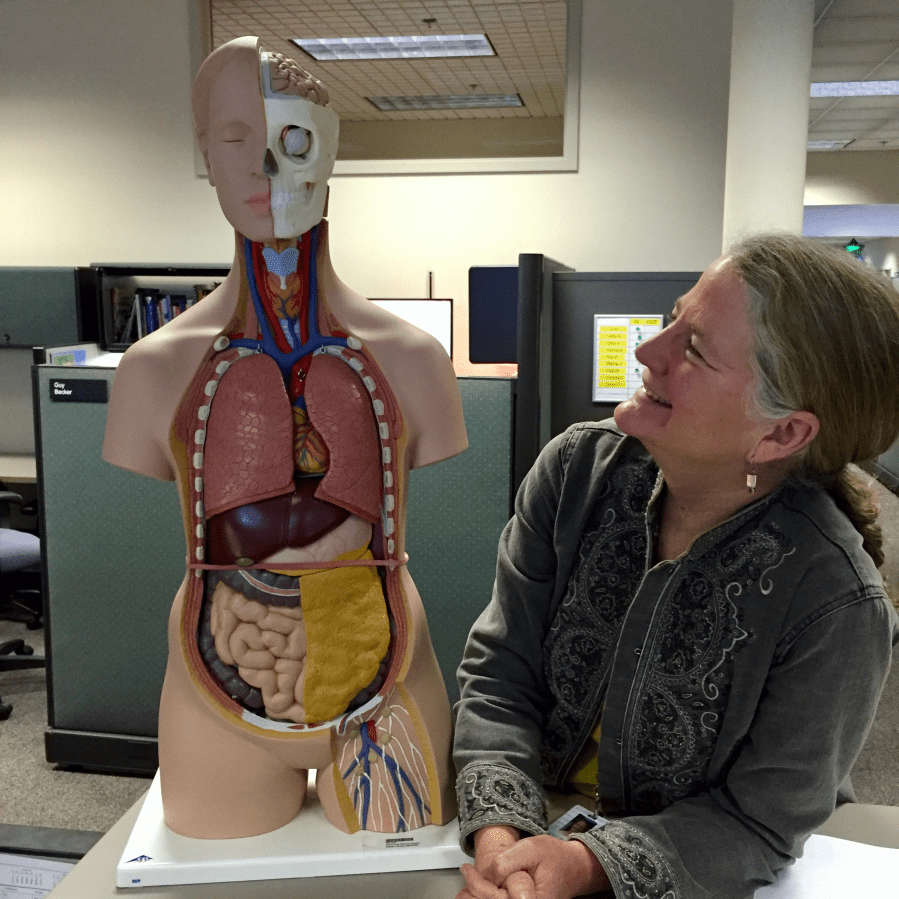
I stood for a full twenty minutes in a Nicaraguan cemetery under mi sombrilla and alongside my friend, Xiomara. She was trying to describe the meaning of the word huesos. Of course she knew the exact translation in English. In the interest of my language learning though, we had agreed to use only Spanish on our afternoon explorations around the mountain town of Matagalpa. Xiomara tried synonyms like esqueleto and marco del cuerpo and related words like piel, vasos and médula. She gestured and pointed to various parts of our bodies.

Under a clear celestial blue sky we stood, surrounded by long white boxes and grave markers.  Colorful plastic flowers and banners decorated the landscape. We’d made our way up a hill and found ourselves before a sturdy white shed. I understood Xiomara to say that the building was full of dry huesos. But I was confused. Since this was quite a different way to dispose of human remains than in my culture, it took me a long time to connect that huesos were….bones….and this particular casita was full of them.

When I finally understood the meaning I exclaimed, “Bones!” Joyfully, we grabbed each other and danced among the dead.

The next day my host family invited me to a small Evangelical church for mass. They knew I taught preschoolers so rather than subject me to the long adult service, they positioned me in class with the pastor’s son where he guided the youngest children. When he asked me to lead a game, I almost squealed with delight. Déjà vu! In that very moment, I remembered learning “Dog, dog, where’s your bone?” while in Sunday School 50 years ago. I could now translate this question and teach the little ones on the dirt floor in front of me, “Perro, perro, donde está tu hueso?” Don’t ask me how this related to the learning objectives for the day…perhaps about being joyful or the lost being found?

Bones, the solid frames we all share.

“Dem Bones,” the camp song my sisters and I led in a sing-along to end my father’s memorial service and transition to the reception.

Bones, the chips that can sometimes be identifiable in ashes after cremation. The same particles my priest Nancee warned me about when we prepared to take ashes home to Virginia. Apparently they scare some people.

Recently my study group at the cathedral read Ezekiel’s story about a valley full of dry bones. God tells Ezekiel to preach to the bones. When the breath comes into them, they rattle and gain sinew and skin. Then they stand on their feet again. They live. In the wake of this powerful prophecy, all of my stories about huesos and bones came tumbling back.

Because this is my experience with bones.

For a long time the best description of intercessory prayer I could muster was a paraphrase from Madeleine L’Engle. She said, “Every fond thought is a prayer.” This made sense to me.

Recently though these fond thoughts have become the bones. The more details I know about a situation – what a person needs, how he or she hurts…take for instance when my daughter called to say her dear surrogate grandmother had died…or when my friend emailed to say that while his kid had survived major surgery, she now suffered “world-class constipation”…or when yet another friend relayed that her son had caught her husband in a lie that exposed his long-time affair and could end their marriage – Yes, the more details I know the more flesh these prayer bones have and the more often the fond thoughts come.

For me this is when the dry bones breathe and live. They stand on their own feet. Spirit is in them and they are placed upright on the earth as well as in the rich soil of my heart. I can hold them there and help assuage the suffering. When I hear my daughter’s tears or recognize the specific bodily discomfort or know the names of the children who will flail and sob as their parents’ marriage crumbles, then I can put flesh on dem huesos and weep too. The valley doesn’t seem so desolate anymore, nor as lonely. Instead even in pain and loss, life and breath and spirit wait. The bones will first rattle and then live, even sing and dance again.

It seems incredulous really that something so very basic as bones – huesos – especially dry dead ones could be stacked in a hut on the side of a hill in Matagalpa and could be the centerpiece of a children’s game stored in my memory for half a century. They also can live as breath courses through them again and can represent prayer in all its fullness and hope. In this way, they become metaphors. I recognize myself as poet, feebly describing the delicate difference between life and death again – basically and finally not very distant from each other at all.


Bouquet with Harvoni

bouquet

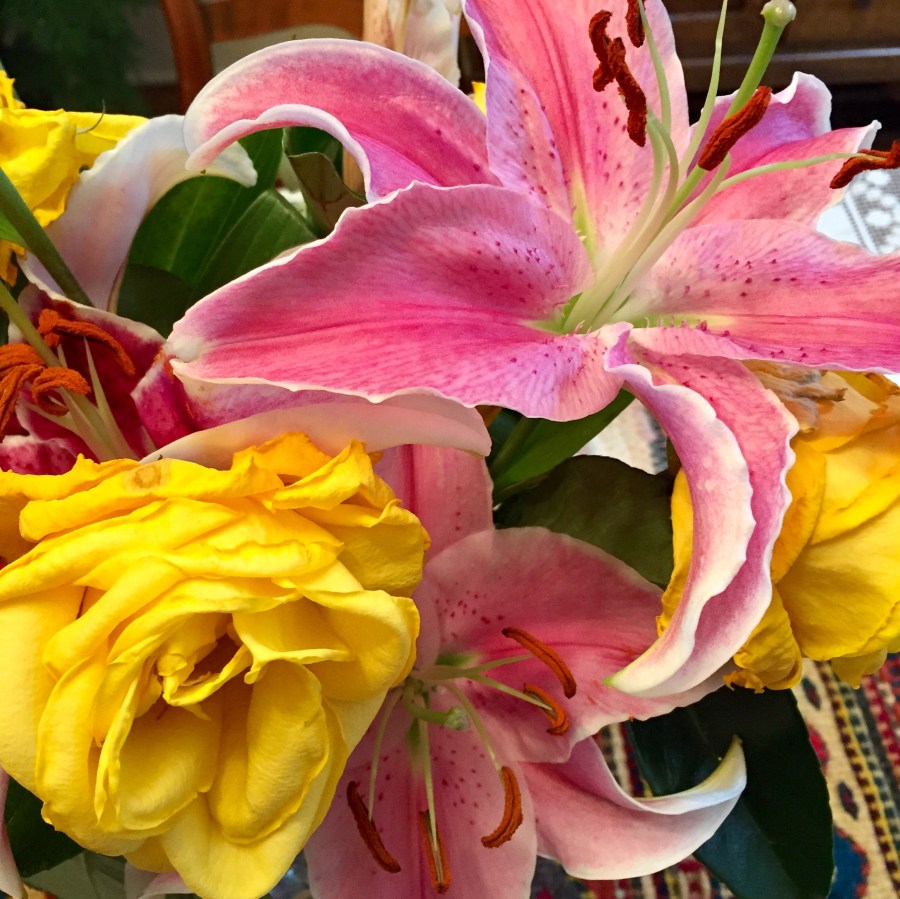
The last thing I noticed before we left home was the bouquet of flowers Rob gave me for Valentine’s Day. I considered bringing them along with us but instead consoled myself with a photo. The flowers reminded me of our marriage. A week ago the newly-opened yellow roses were perfect, wafting a gentle aroma when I drew near. Velvet green leaves and long lily buds pierced up between the sunny orbs.

I remember when we met almost 40 years ago. Our love was young and fresh. We too, like the flowers, were still perfectly formed. Four days (and four decades) later the roses had become wilted blobs hanging on weak stems. Simultaneously the Asiatic lilies had exploded into full glory – large white blossoms with pink stripes and dots surrounding fuzzy maroon stamens. Their incense permeated the dining room and I laughed out loud, realizing that I’d imagined these jewels as symbolic of my marriage now.

How did this happen?

Rob and I met when we both enrolled in a climbing class at REI. Not unlike unblemished flowers, our stretch of pristine beauty extended longer than that of most couples because we lived together three years before marriage and then waited to have kids. When we welcomed Clarke and Carolina into our bouquet, we were ready.

Our kids were school-age before we learned Rob had Hepatitis C (HCV). He’d probably been infected all of the time we’d known each other because he received tainted blood the year before I met him. Thanks to a procedure that ultimately saved his life, he’d contracted an insidious virus that would eventually destroy his liver.

After diagnosis, Rob’s best response was to stop drinking alcohol as he waited for a possible cure and begin fighting back the depression that surfaced. Modern medicine along with music, a significant job-shift and love from the communities we’d built at church and in our neighborhood helped him move forward. Eventually he retired, restored a piano and created our garden. Soon he’ll be a beekeeper.

Years ago, Rob could have chosen a complicated chemotherapy treatment to address the virus. After several months of side effects, he’d probably have beaten the little devil. But since his liver was only slightly scarred (rated 2 out of 4 in terms of damage), he could afford to wait.

Until today, when we find ourselves in the middle of a magnificent healing bouquet. That’s because a couple of years ago, Harvoni came on the scene.

  • A new drug offering almost 100% eradication of HCV.
  • Minimal side effects – only headaches and weakness for some patients.
  • No cocktail, just one pill per day for three months.

When Rob went into the hospital for his third liver biopsy, he was surprised to be greeted by a nurse practitioner we know. Mary Sue Galvin was our neighbor pre-HCV-diagnosis when we lived on the houseboats. For me, this coincidence was enough to consider him healed. With Mary Sue running the department and looking out for us, what could go wrong? Still, Rob the economist waited. After all, Handsome Harvoni was expensive. We decided to wait until insurance companies were required to cover most of the $100,000 tab. Then we waited a while longer to avoid the double deductibles of spreading the treatment across two calendar years. Rob took his first pill on January 2nd. Welcome 2017 and Harvoni! Good-bye Hepatitis C!

Some people suffer through gruesome surgeries alongside their lovers. Then come long recovery periods before strength is regained. Me? I’ve just listened to Rob’s tales of insomnia. Sleeplessness is not a side effect of Harvoni per se but Rob believes it’s a discomfort that arises when he’s not operating at 100% capacity. Also, no alcohol is part of the regimen and I’ve joined Rob on the no-booze kick in solidarity.

How dare I complain though? One thing I’ve liked about this period of our lives is being ever-conscious about the healing that’s happening right in our own home. About a month before Rob started popping pink pills, I was overcome with joy at one point, certain he was going to be well after beating this virus. Then 30 days into the treatment, we had our proof when they checked the viral load in his blood. First glance of the results showed a chart with October 2016 counts alongside late-January 2017 numbers. In October, millions of HCV microbes showed up. But beside the January date on the grid? “None detected.” His liver counts are improving too.

Truly we have lived our lives fully for the past 20 years. We traveled. We raised our kids. Lots of laughter and loving. Still in the shadow of HCV, I’ve had my blood tested a few times (uninfected) and I’ve learned about liver transplants. Now we know, blessedly, HCV and liver disease is not what’s going to take him down. We could be one of those privileged couples who live into deep old age together. No wonder the gorgeous voluptuous lily seems so like us.

But if I am honest even now, I know that by the time we get home those same pink petals will let go and drop off. The stamen dust will drift and spot the tablecloth. We’ll have a mess on our hands. And I’ll acknowledge those times when I feel distant from Rob, those times when we’ve hurt each other or just couldn’t care less. In so many words, when we’ve had a mess to clean up. And we will again. We’ll continue cycling – close, distant, blobs, jewels and messes. Regardless, in late March, post treatment when he turns 67, I’m definitely imagining a toast with whiskey on the rocks coming up. In the middle of this life bouquet of roses, lilies, Harvoni and each other, “Salud! Here’s to us!”


Racist Remarks

carolina-and-dana

My niece called me on a racist remark at dinner the other night. Not in an accusatory way, mind you, just matter-of-factly. She had described her reluctance to eat street food at her home in Beijing and I chuckled and asked, “Why? Because it might be dog?”

“No, that’s racist,” Dana replied. “Most Chinese people think that’s disgusting too.”

I was slightly taken aback. While I hadn’t meant to discriminate, I could see her point. I look down on eating dog and I’d captured a whole group of people in my ignorant comment. As it happened, I’m glad she used the r-word to describe my behavior because it got my attention. I don’t like to think of myself as racist but, like it or not, I do carry the privilege of being white in a society that has given those of my race individual and institutional power throughout history. I’m glad Dana shared her judgment right away in the moment and was not antagonistic. As a result I had to agree and then could reflect on how I’d like to speak differently next time. I could acknowledge that I have a lot to learn in this arena. Since I don’t intend to hurt others or treat them unfairly, I want people to tell me if my comments seem aggressive or mean.

Later Dana’s response encouraged me to backtrack on a related incident. I had been finishing lunch with a group of colleagues when one woman laughed as she imitated her grandson mimicking a Chinese accent. I had finished eating and was leaving the table so while I recognized this remark as racist and felt awkward, I didn’t call her out or at least ask her intent. But after my personal lesson with Dana, I decided to retrace my steps, voice my discomfort and ask my co-worker what she’d meant. Unlike Dana I hadn’t been brave enough in the moment but, later, I asked my friend if she would have told the story in the same way if a person of color had been with us. Even though she didn’t see the incident as I did, I left our follow-up conversation with a clearer conscience, emboldened to give immediate feedback in the next instance.

After all we teach kids not to be bystanders who allow bullies to hurt others. I think being silently complicit to racist remarks is an adult version of the same unacceptable behavior. I want to do better.


Feelings re: Politics

with-her

My morning practice includes journalling and reading my entries from a year ago, a month ago, a week ago and just yesterday. The last ten weeks have been loaded with “feeling words.”

Post-election: Shocked. Alarmed. Unnerved.

A week later after reading “Arrivals,” a poem about new immigrants by David Whyte, then sharing our own bridging stories with colleagues: Curious. Appreciative. Encouraged.

In between times given the consistent and general background malaise due to news of presidential politics: Dread. Disgusted. Uneasy. Distracted. Afraid. Worried. Apprehensive. Forlorn.

Then inauguration weekend.

Thursday after reading together from The New Jim Crow, a book about racism by Michelle Alexander, then sharing our own stories about undoing institutional racism: Disappointed and heavy hearted. Also curious. Compassionate. Open.

Friday after accidentally turning on my phone and seeing the Obamas board the plane to end their era as our leaders: Bereft. Deeply sad. Fragile. Wretched. Vulnerable.

Then after seven hours volunteering at Seattle United, an event to connect immigrants and refugees with attorneys and other services: Engaged. Elated. Pleased. Grateful. Refreshed.

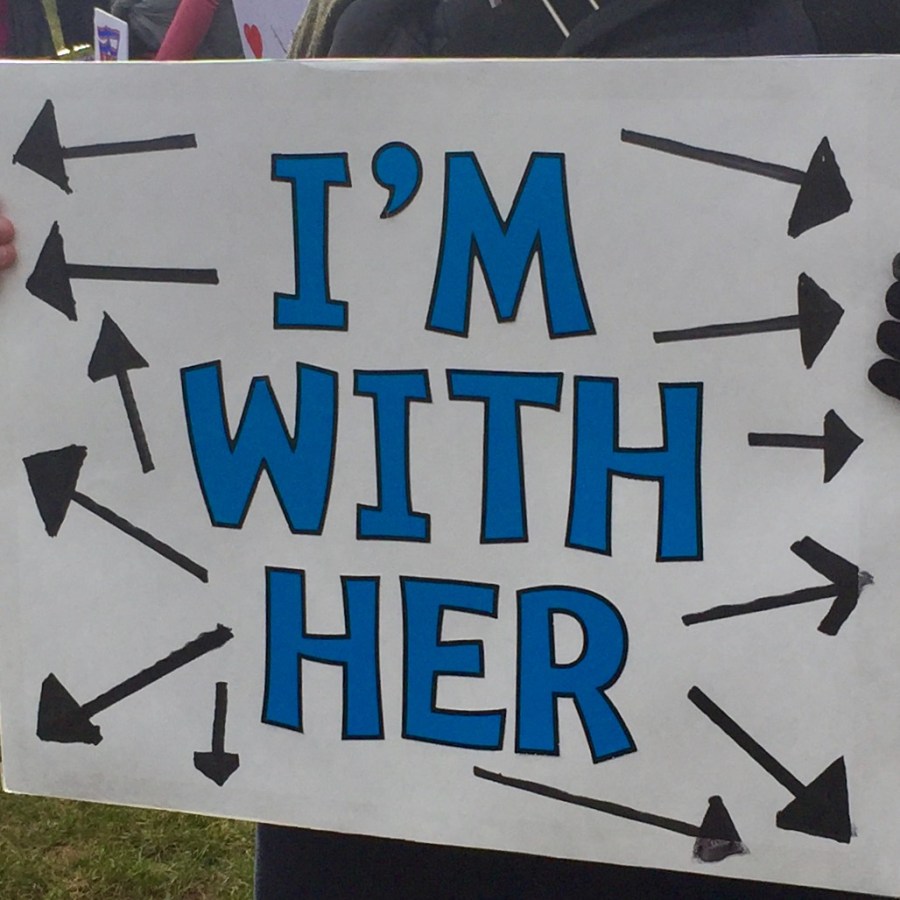
Saturday after the womxn’s march, sitting on my sofa alone, seeing photos from around the globe of others who marched, millions of us…er, at the very least, a million of us: Spellbound. Amazed. In awe. Invigorated. Deeply touched and moved. Inspired.

Like we can do this.

The next morning I sat in bed, still in pajamas, with my sister, studying Jennifer Hofmann’s Weekly Action Checklist. This is where we started. Some people have been doing this since Day 1, preparing, making it easy for us to be steadily politically active and not burn out. We each picked our three focus areas as Jen suggested. Then we located contact info for our congresswomen and senators. Then we left messages on the phones of those leading action we oppose. We donated. We committed to twenty minutes of this targeted work per week. It was good to be together.

Empowered. Determined. Proud. Invigorated.

Yes, we can do this. Yes we can!