Blog

Voy a Bailar

dance colibri

There’s a bunch of standard ways to stay healthy in the tropics when off the standard tourist beat: drink filtered or bottled water, wash your hands, wear shoes. But if you want to be well, it’s best to dance.

For older gals like me, you’re extra lucky if you have a son who is a musician and teaches Spanish to middle schoolers. In early 2018, mine sent me links to several current Latin tunes in response to a request for wholesome music we could play at my elementary school’s multi-cultural night. So when I went to Nicaragua, I had a mix of some of the greatest.

One—Soy Yo by Bomba Esteréo—is about a girl with confidence. The video tells her story as well as any words could. The morning after I got home I visited our 6th grade classrooms to finish the lessons on preventing child sexual abuse. In our district, elementary school counselors are required to discuss this topic in all classrooms each year. I realized while driving to work, less than 48 hours after I’d left that warm, sweet tropical climate behind, that the first story I’d share with the kids was the one about this child who proclaims “Soy Yo” (“I’m Me”) and chants to herself “Relajar” (“Relax”) and “No te preocupes” (“Don’t worry.”) Since sexual abuse has had a significant presence in my FOO’s story, I know how important restoring confidence can be. The second clip, a story told by a 12-year-old who was regaining his confidence after telling the story of being abused, was softer to hear and then discuss after Soy Yo.

Another favorite tune for me is Vivir Mi Vida (Live My Life) by Marc Anthony. The video doesn’t live up to the fantastic lyrics and rhythm but non-Spanish speakers can always tap into Google Translate for help.

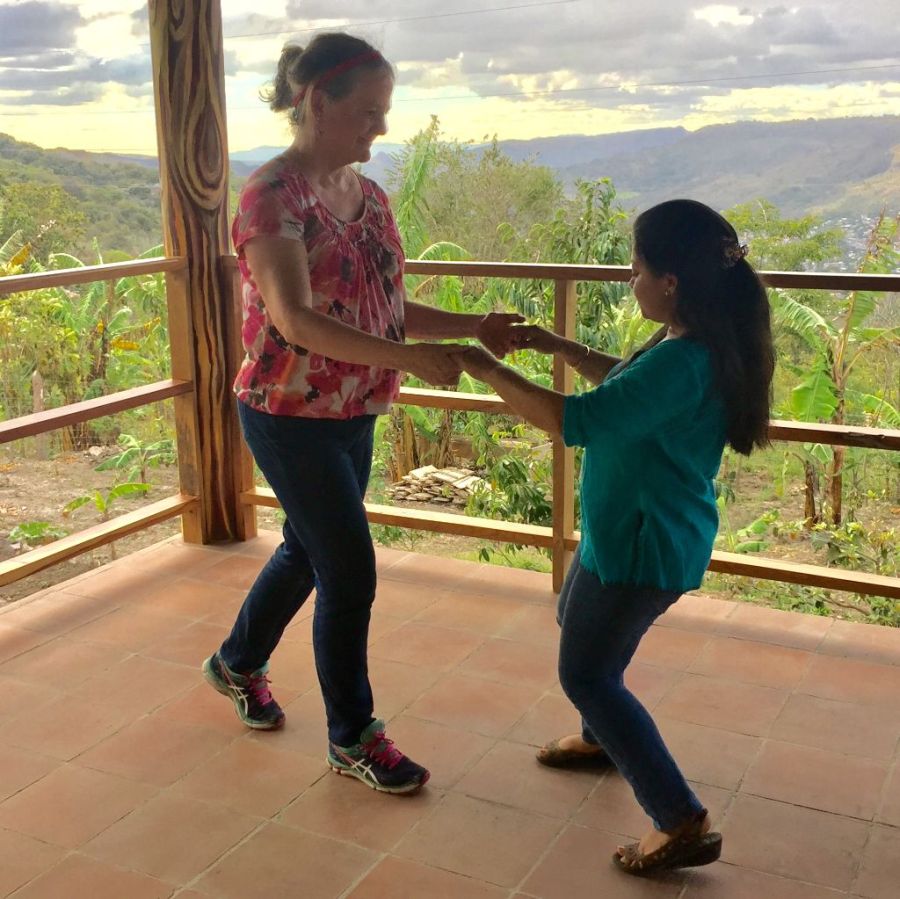
During my recent trip to Nicaragua, whenever I felt myself start to tighten up, I called up a tune on my iPhone and danced a few bars. For a change I remembered the salsa steps from the dance lesson earlier in the week and danced in my pajamas one morning with my homestay kids, all of whom are semi-pro folkloric ballerinas.

Thank you, Clarke Reid, Teacher Man. Such a fabulous idea to enliven classes by exposing your students to new tunes from Cuba, Columbia, Puerto Rico, the DR, etc. Then after they’ve successfully learned the lyrics by the end of the week, rewarding them with the video. Much better than verb conjugations drill…much better. Then gifting your grateful Mom with the playlist. Gracias, muchas gracias.
Voy a Reír

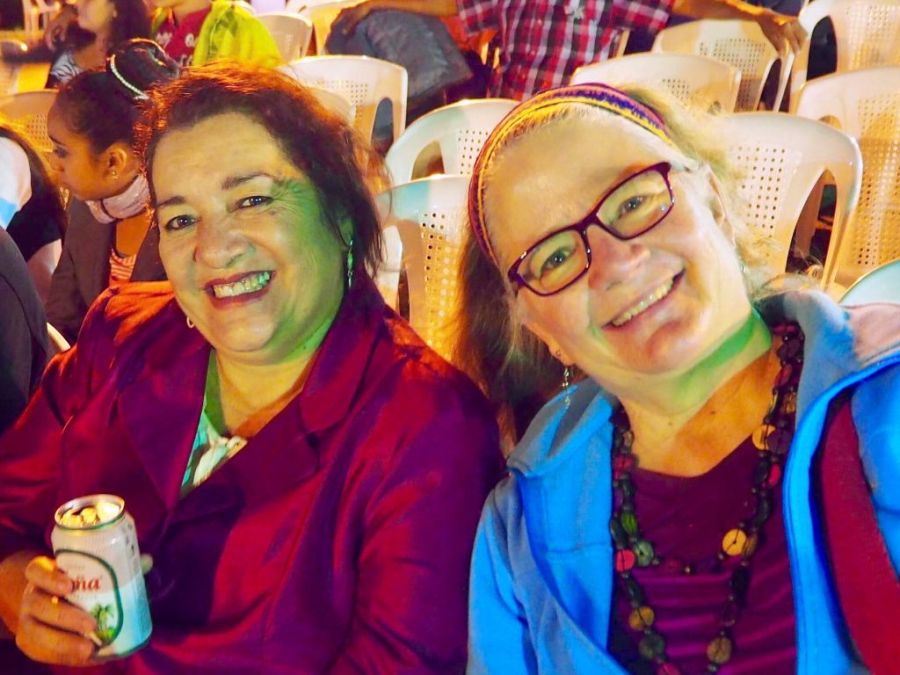
Marlene and me

So this girl, Marlene Castillo, and I are becoming famous for our escapades. At least in my heart, thanks to her big one. I stay in Marlene’s compound-like home when I visit Matagalpa, a city in the mountainous tropics of Nicaragua.

When we are together the laughs are free-flowing. These days I understand most of what’s going on. For instance I could throw in a word or two when we talked local politics with the retired Texan who showed up via Airbnb speaking near-perfect Spanish. He even had enough faith that he coached me about use of the subjunctive tense. Ha! I’m still trying to use the correct past and future tenses without slowing down the conversation too much. And my vocabulary will always be developing. By now I know one word for most things…which reminds me that there are several for purple. I’m grateful Marlene used the right one the other day at breakfast.

Every morning she makes a hot breakfast and serves it promptly at 7 before my Spanish lessons at Colibrí commence. Most family members were already on their way on this particular morning. So she sat down at the table to eat and chat with me. Joaquin, her quiet husband, also joined us for the first time ever. Don’t get me wrong. I like Joaquin a lot. He reminds me of Rob. He is a capable provider, a builder and professional driver. While I could never translate it, I get his dry wit. Marlene has perfected the clarity of her speech plus the use of her hands and acting acumen to make communication possible with even the most elementary Spanish speaker. But Joaquin, like most Maltagalpinos, drops the s’s at the end of words and relies on his eyebrows and lips to tell a lot of the story.

So when he started speaking that morning I perked up. I didn’t want to miss a bit of his tale. Between the two of them they began telling me about work he does with Marlene’s cousin Janet in the nearby rural communities. The story centered around a new-to-me verb—barner, or was it barnir?—and its first person present conjugation. As sometimes happens Marlene was translating my Spanish into words that other Spanish speakers, in this case Joaquin, could understand. Still we were stuck.

Finally Marlene looked squarely at me and used two cognates out of the three words she articulated to describe things as simply as possible. Bless God for cognates—the 20,000 words that are similar in several languages including English and Spanish. When read they are easy to translate. When pronounced, not so much. Still the three words were: Grande (a Spanish 101 word which means Big…Marlene held her arms wide though just in case my brain was still a blank vacuum), Violeta (thank God this was the choice she used for purple instead of morado or lila or even púrpura because the others may not have made it through my haze) and then televisión (and you all know what that means.)

Bravo! Ka-rum-ba! They were talking about BARNEY, for God’s sake. No wonder they continued to give me a chance to figure it out. I work with little kids after all. I had raised a couple of my own in the shadow of this jolly purple being and they were telling me that sometimes Joaquin dressed up as Barney to teach the kids when his NGO visited the countryside. My God, did we laugh…until my sides ached. Voy a reír (I’m going to laugh.)

I think this might be a story I’m supposed to keep under my hat for some reason. I mentioned it to Janet a couple days later when we were all together for Matagalpa’s anniversary celebration (that’s a story in itself). Given the way eyebrows flew and lips curled when I started into it, I decided to message Marlene before posting.

She, and Joaquin too, gave me permission to share this tale. I am still not certain why there might be any hesitation. It could be the Santa Claus phenomena…when someone is dressed in a great costume they become the character and that’s all there is to it. No one has permission to mess with the fantasy life of children. Anyway, that’s the way it is with my Spanish…I miss the details and have to rely on my read of body language and basic intuition a lot. Luckily over the years I’ve come to trust both of these ways of knowing in addition to what the words tell me.

And some tales just beg to be told, especially when the joke is on me, the teller, or the listener as it were. After all, in our parts we never let the truth get in the way of a good story. Who’d want to do something silly like that?


I Am Home

Jewels

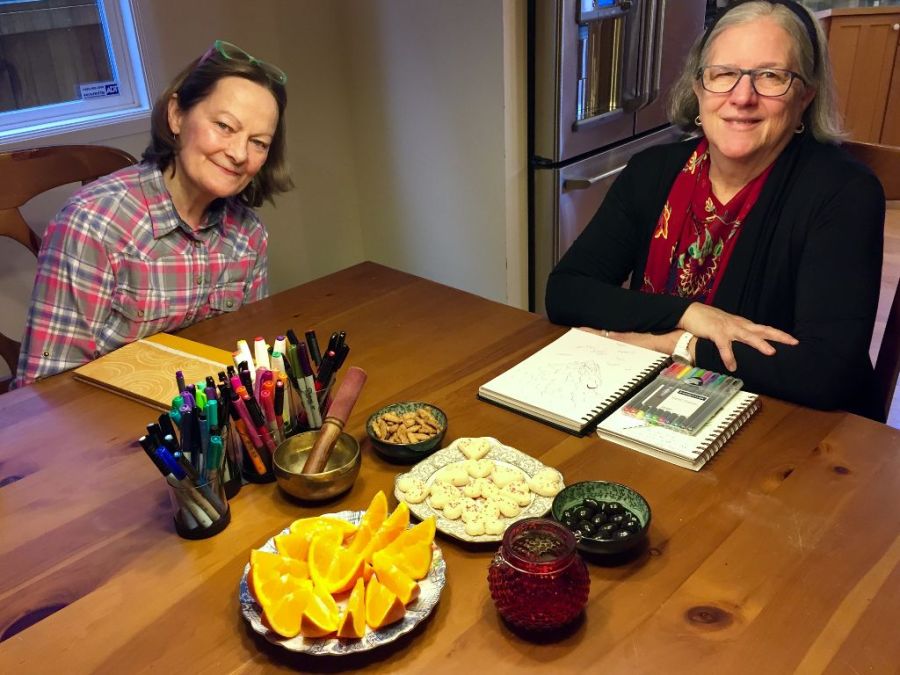
Valentine’s Day began shortly after midnight on the 14th when my love Rob Reid picked me up at the airport after a long trek back from Managua, Nicaragua. Early the morning before, I’d had the good sense to swim in Laguna de Apoyo, before ten hours in the air and finally un abrazo grande (big hug) in the welcoming arms of my favorite husband. Since Valentine’s Day fell on a second Wednesday, I slept a few hours and then joined my creativity circle—The Jewels—for our monthly rendezvous. Ordinarily this might have exhausted me. Instead I had enjoyed ten days away and each day I had carved out time by myself to draw, meditate and reflect—a strategy I’d learned as part of this very trio. Being with these two good friends on my first day home seemed like an extension of my trip, the perfect antidote to re-entry jet-lag and a way to let the beauty of liminal space carry on.

And this trip…why so special?…why so necessary?

Some background: Three years ago my Dad died. Then my dog died. Then I published my book, Bridging Languages, Cultures and My Life, essentially about my five years traveling back and forth to Nicaragua and learning Spanish in middle age. It’s also about being at home…and learning to take this feeling of contentment and basic pleasure with me wherever I go. My creativity practices help in this quest. In fact they are life-giving.

I have marveled at others who travel around the world, moving seemingly effortlessly across borders, between languages, back-and-forth, to family, to work. People who stay well and don’t seem to stress much about it.

I realize, bless Pat, after ten days in Nicaragua, finally back there with Marlene and her beautiful family, that I am one of those people.  And as an educator, I was lucky to be in Matagalpa for the first day of the children’s school year. The younger ones in my household were school-aged—one started preschool, one his first year of secondary school and another started her final year. Talk about a fun evening to be welcomed into the conversation of my Nicaraguan family.

After Marlene’s I added two days for intentional reflection at La Abuela’s, a Nicaraguan-owned refuge and cabins. It’s situated in an ecological reserve beside a gorgeous lake in a volcano’s crater. Here was a place I could swim in what Nicaraguans call agua dulce—fresh warm water that has the slightest hint of salt, not enough to taste or sting my eyes but enough to hold me up while I floated and pondered my very good fortune.

Most of this trip I studied at the Spanish school, Escuela Colibrí, newly located on the side of Cerro Apante in the mountain town of Matagalpa. In fact, they set up the homestay so that my Spanish learning continued 24/7. More to follow about Colibrí in subsequent posts. For assistance with other travel around the country, I used and highly recommend Matagalpa Tours, a sister business of the school.

Now that I am reassured I can stay healthy and have a blast, I am tempted to sign up quickly for the longest stretch a “tourist” can manage. This is definitely what my Spanish needs so I can be fluent.

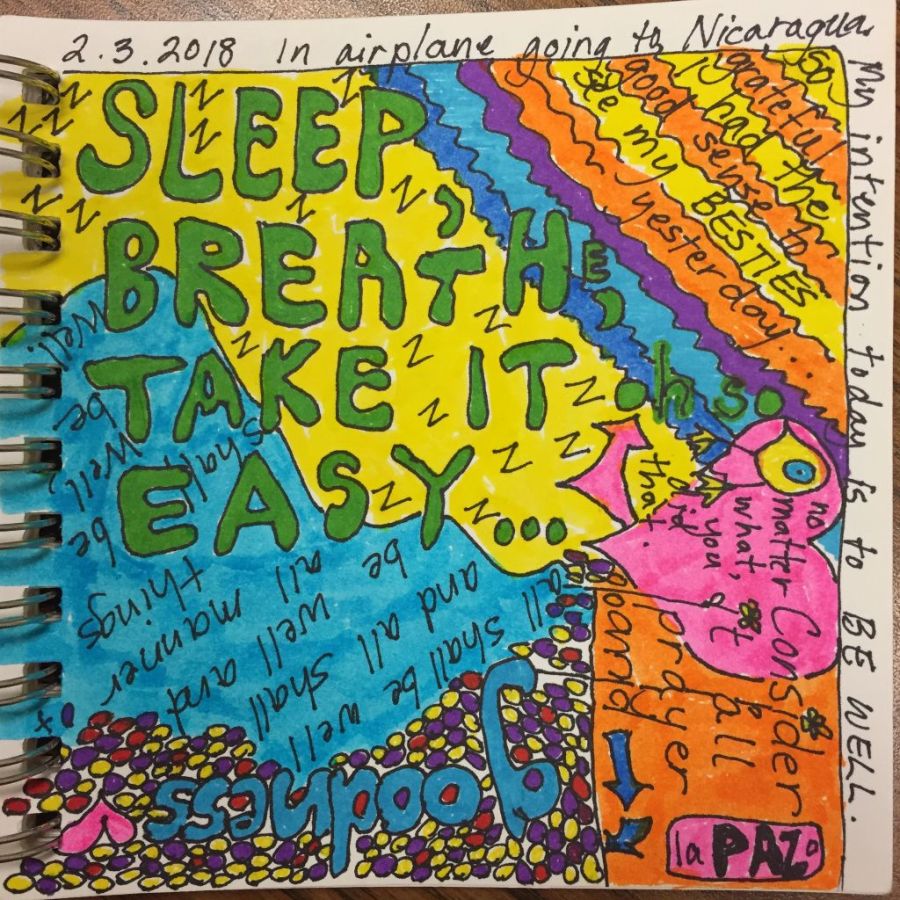
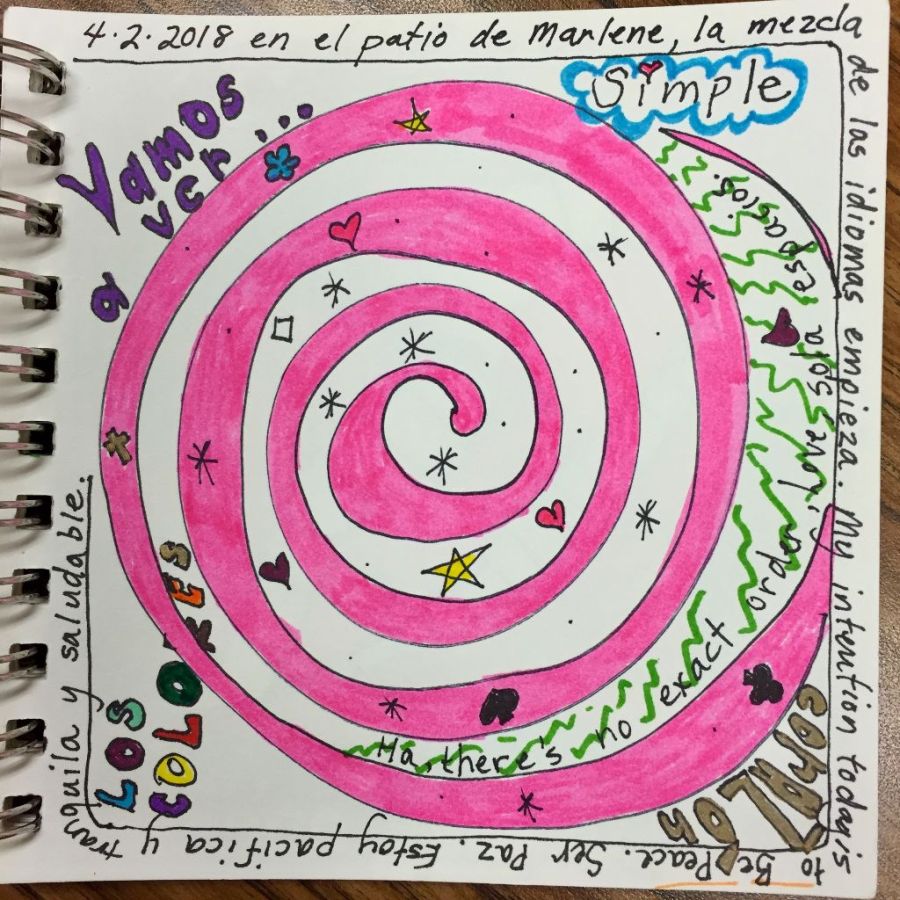
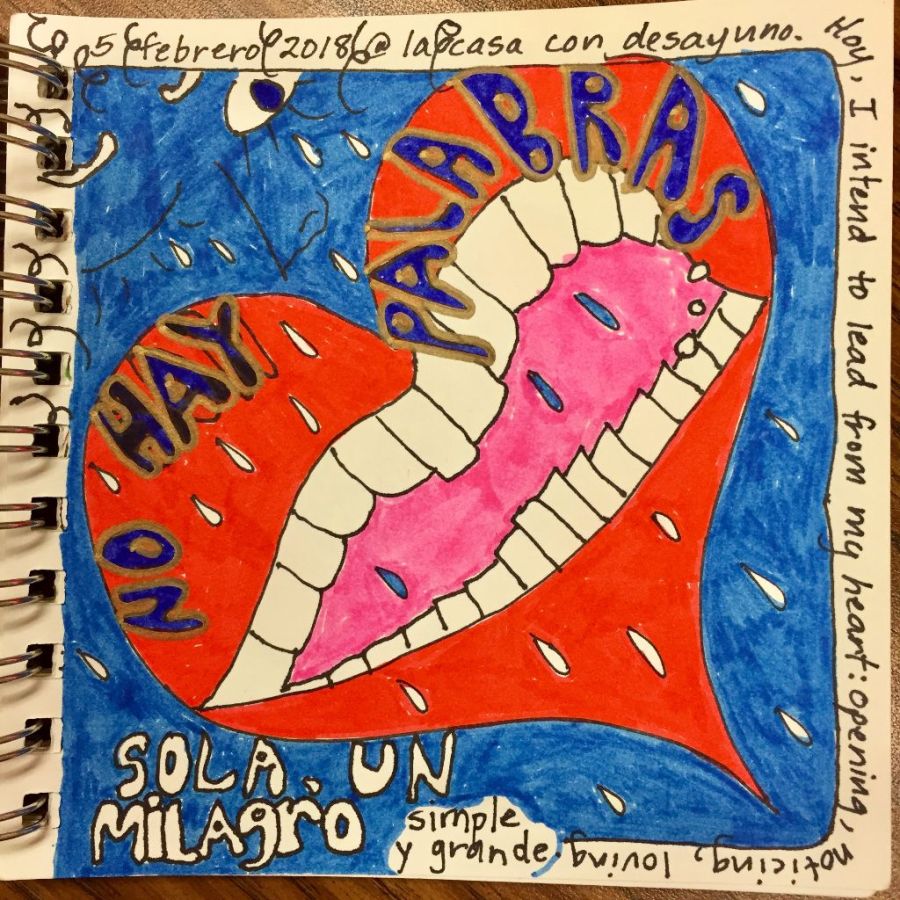
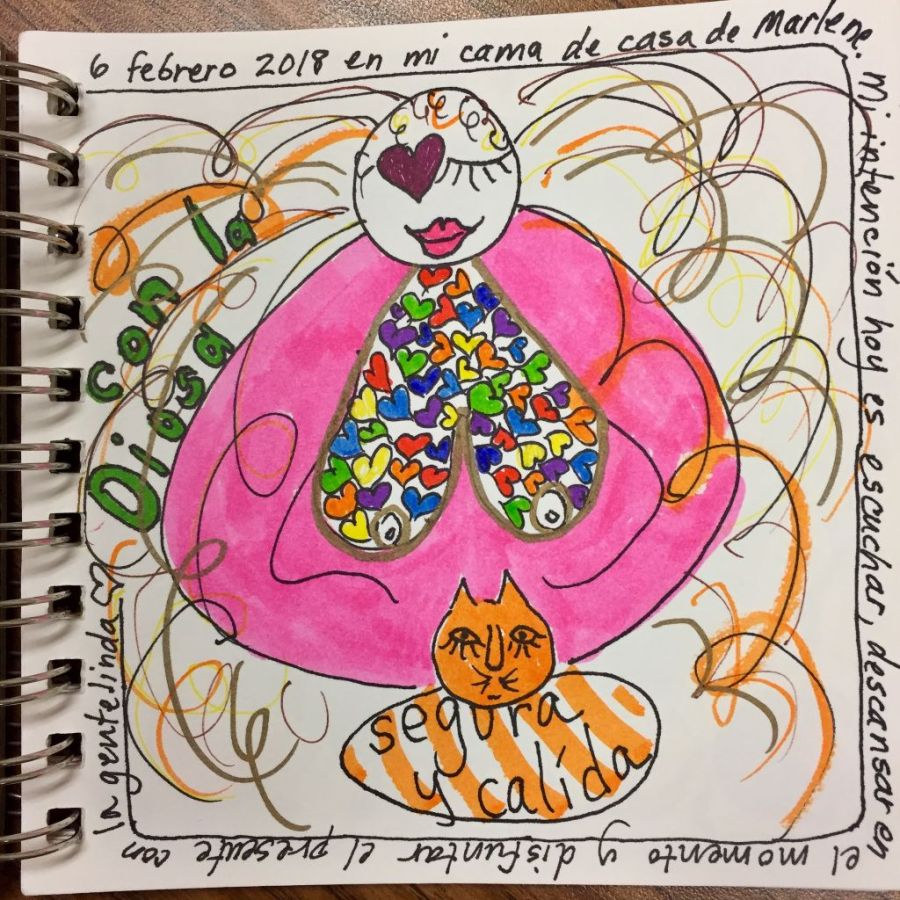
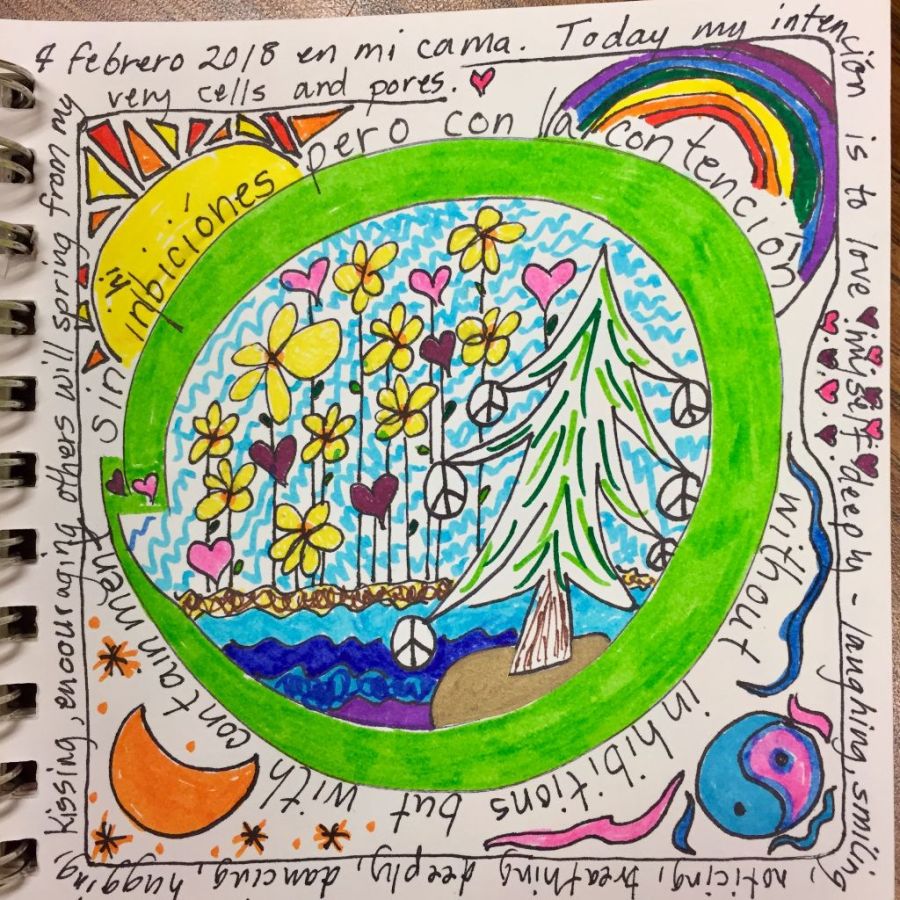
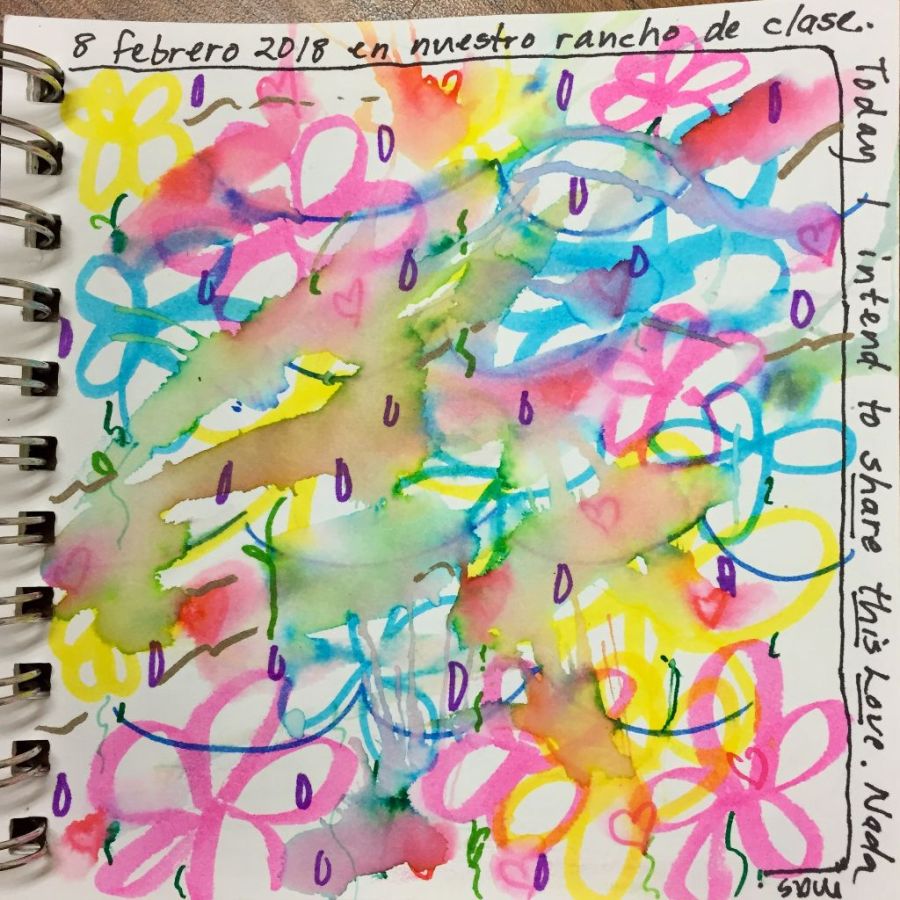
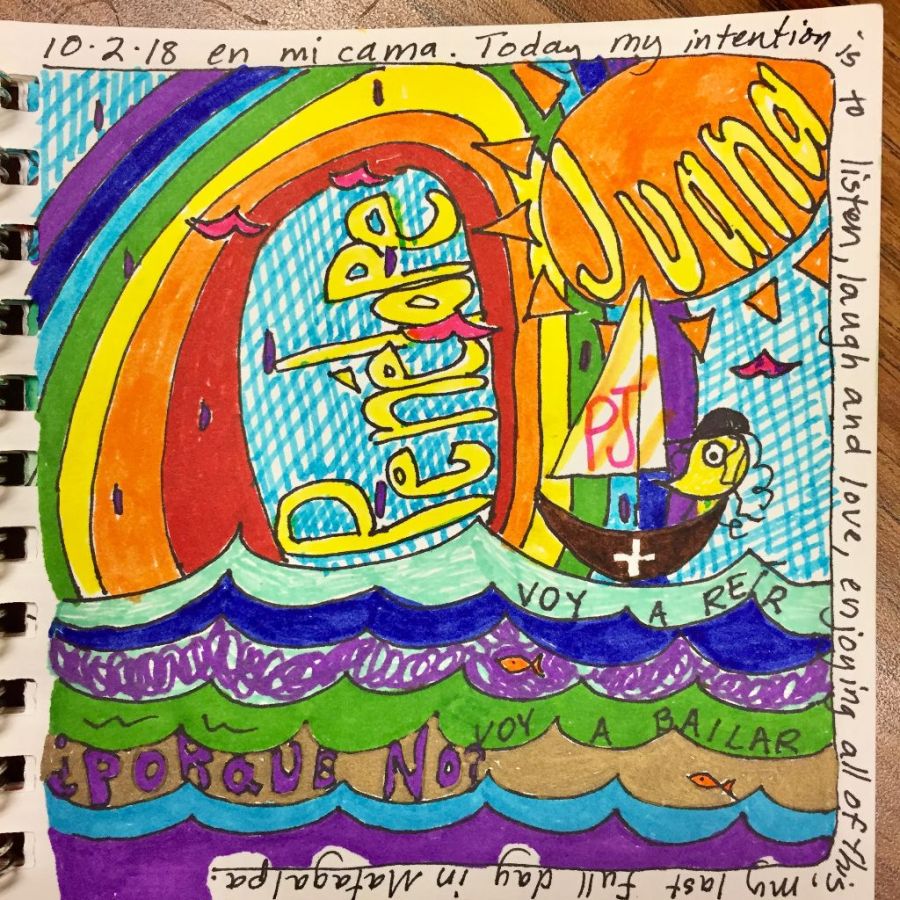
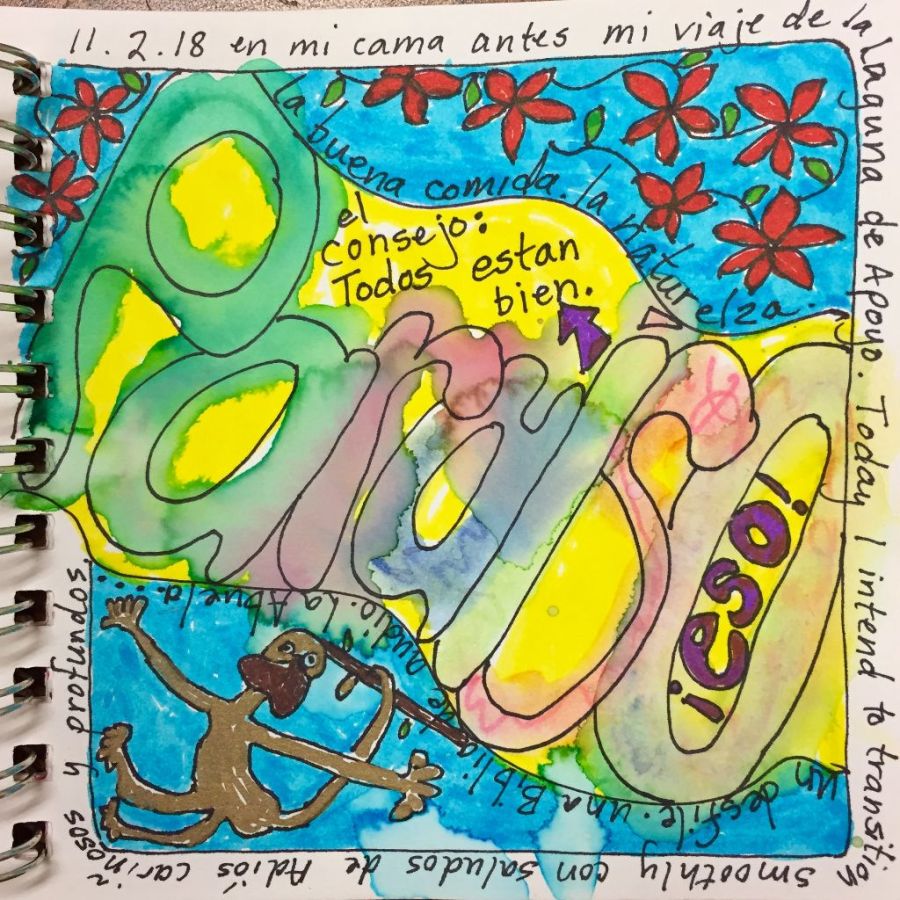
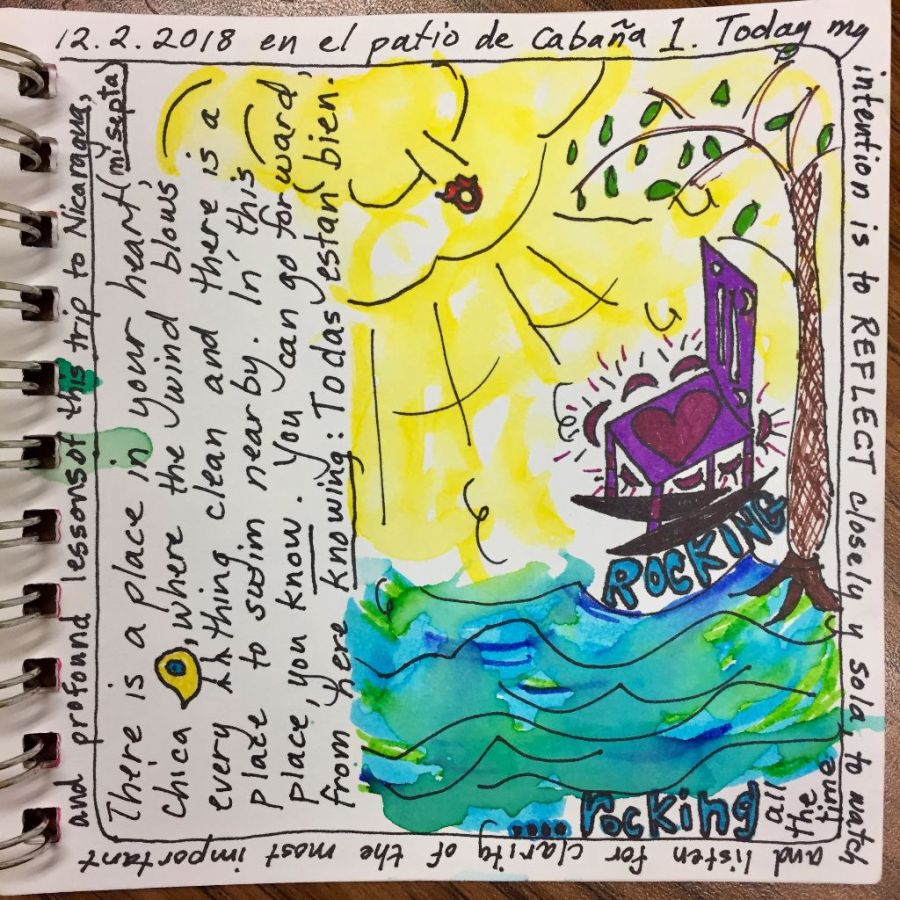
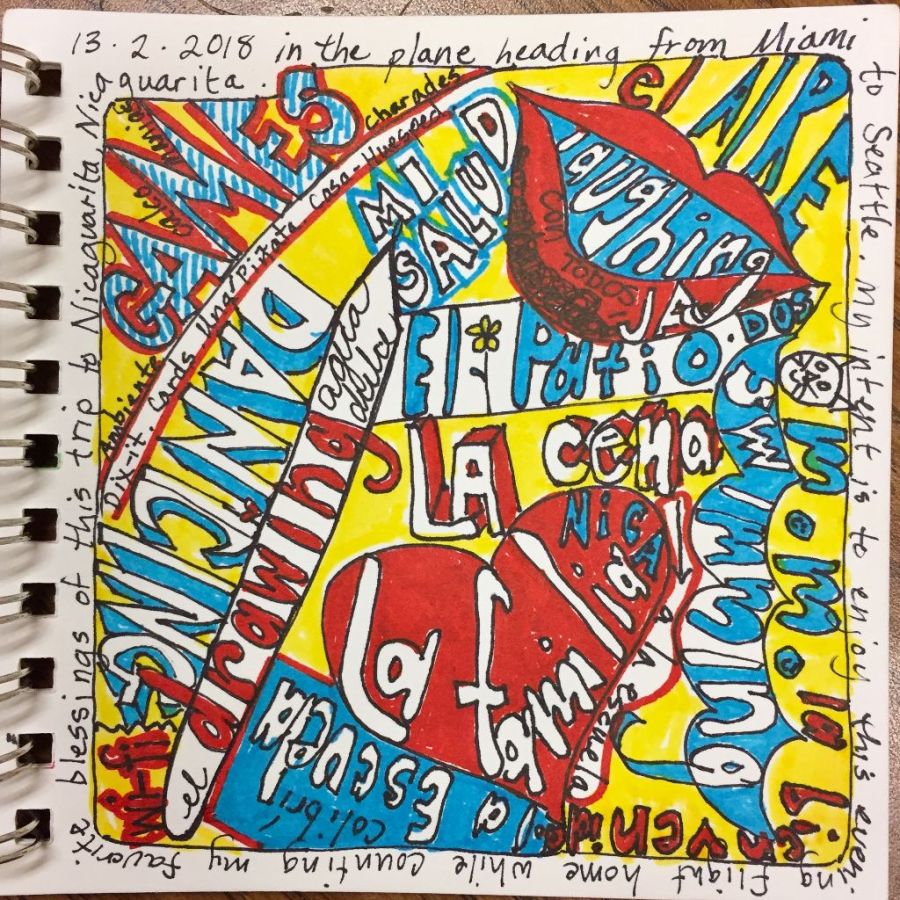
What is the secret for me? Yes, drinking filtered water and washing my hands helps. And now there’s even wi-fi at Marlene’s and La Abuela’s cabins so it’s possible to stay somewhat connected, if desired. This helps too. But mostly it’s about laughing and dancing every chance I get. I also finally know how important it is for me to carve out quiet, alone time every day. My intention was clear and I re-visited it every day. These drawings are the result:

2 3 18

2 4 18

2 5 18

2 6 18

2 7 18

2 8 18

2 9 18

2 10 18

2 11 18

2 12 18

2 13 18

Knowing God

Nic flowers

Once I calmed myself enough to help a tiny chickadee who’d flown into our cabin and couldn’t find her way out. She perched on my thumb for all of 60 seconds while I carried her out then set her free.

Yesterday we found the one hour of late afternoon sunshine to walk a two mile loop of the beach. Fierce howling wind and rain had surrounded us most of the day as we watched transfixed from our nest—snug second-floor living spaces at the beach cabin. Bundled up and finally outside, we walked then gazed in awe at the ragged bright-white caps and rainbow framing an ocean that reaches halfway around the world. We’re inside again now and it’s hailing—giant balls—through the sunshine. Somewhere out there is another rainbow.

Thus, and there are zillions of such stories over my lifetime, I have known God through nature—when I was young walking a trail with my parents and sisters and spotting one shiny orange salamander after another, being awakened in the middle of the night by howler monkeys in the tropics or hippos on a savannah, soloing through whitewater or up a rock face. Lately the majesty has extended to man-as-God creations: the music in La Misa Campesina, the mix of Latin tunes my son made for me, Sagrada Familia, the poems of Mary Oliver.

By extension, behaviors have allowed me to sit in God’s lap, to use a metaphor. Years and years of serving others—children and families through special education, health access programs, worshipping and discerning with Spanish speakers.

More recently, these behaviors have become less deed-like and more quiet and solitary. Just God and me, God in me, God as me: consistent journaling and meditation practice every morning, breath and body exercises, swimming and dancing, often alone. As a result I know the way forward.

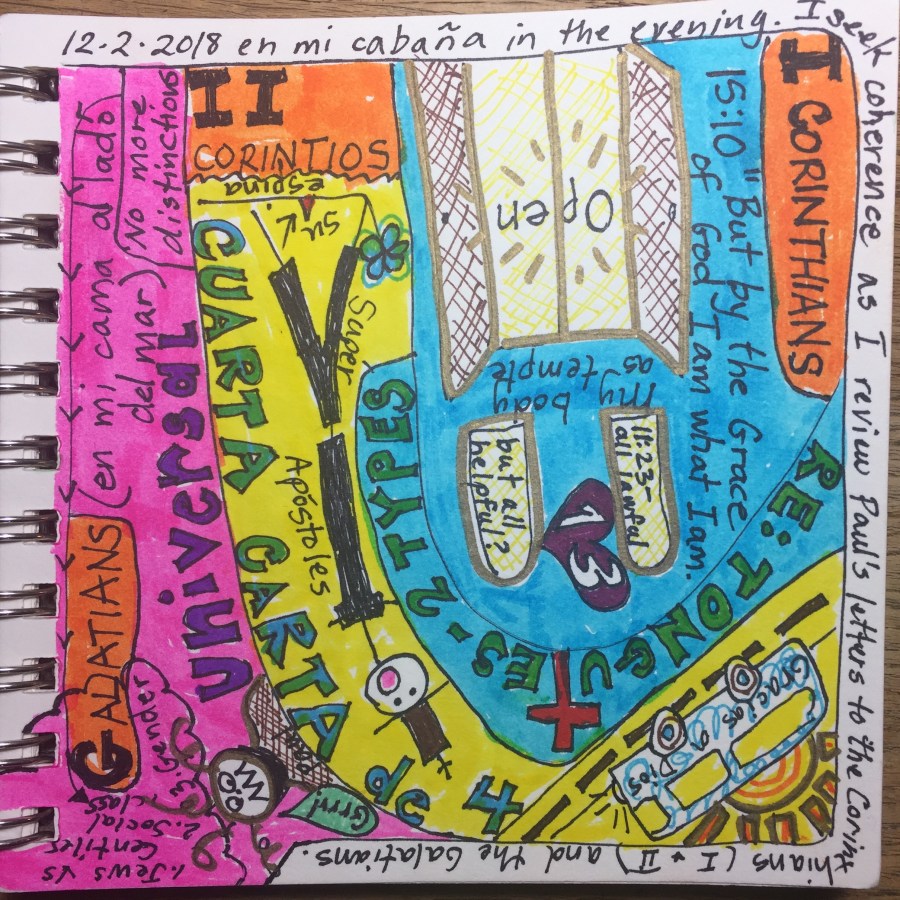
For instance, the time recently when I was riding along with Franklin from Matagalpa to Masaya: I had planned to complete my theology homework while in Nicaragua. In fact, I’d planned ahead and brought my thin Spanish/English New Testament along, the one I borrowed from the Gideons last spring in a Florida hotel. I had already read the commentary from the heavy textbook that I sensibly left at home. I did bring notes with me though, brief summaries about I and II Corinthians and Galatians on post-its. I’d also copied the essay for the meeting after I returned so I could read it on the plane coming home and be ready. But the scripture reading itself of those three letters written by Paul just wasn’t happening. A few verses was a fine sedative but that’s about all I could say for them.

Then Franklin showed me his solar-powered audio device. He’d downloaded the entire Bible onto it and was happy to drum up II Corinthians. I could read along to an hour recitation in Spanish and call it good.

Nic EfM

Once completed, I added my own art review to summarize the highlights of the letters. A bit of a hodge-podge yes, but my intention was clear. My assignments were complete, given this very page of reflection about how I know and experience God and how God reaches me. I know God through the creativity of imagination and through behaviors. Especially during that hour on the Pan American highway, my eyes opened and the scales of any concern fell away.

In the words of Meister Eckhart, “The eye through which I see God is the same eye through which God sees me; my eye and God’s eye are one eye, one seeing, one knowing, one love.”

Microaggression: Not My Intent

circle-photo

I’ve done it again. And I hate to admit it. But since my intent is to at least do no harm, even do my part to improve things—to live/model/teach a better way and finally to connect with and empower others to do the same—I must tell this uncomfortable story.

As part of the equity team at my elementary school, I was invited to hear Zaretta Hammond speak about culturally responsive education and the brain. The event had been slated for the first anniversary of Trump’s inauguration and scheduled long before the women’s marches became public. So while others were walking in downtown Seattle on Saturday, my butt was seated in Renton. My mind was actively involved in a relevant and related activity—a workshop about taking fairness into our schools through excellent teaching. I was fortunate to be present with several from my school and almost fifty others from my district.

Plus lunch was provided. Always a bonus.

As engaging as the material was, linked to the anti-institutional-racism work I am drawn to, my greatest learning started during lunch. Zaretta had encouraged us to visit with someone new over the meal.

I saw an open chair beside a younger-than-me and browner-than-me woman who appeared to be on her own. She encouraged me to join her and we began trading questions and comments and getting to know each other. She was friendly. Interesting too because while we are both educators we work in different roles and settings, me as a counselor in a public school and she as an administrator in an independent school.

I was curious.

Then I said it, not “Where are you froooom?”—God, I know better than that!—but, “Were you born in the U.S.?” Right away, I noticed that she, without skipping a beat, ignored my question. I wish I knew better! In this immigrant-phobic country we now live in, I had asked something that came close to questioning her status. None of my business. I teach people not to ask that, for God’s sake. Regardless of my intent to connect, satisfying my curiosity and anticipating appreciating more of her, she felt hurt, perhaps angered. I knew because she folded her arms across her body and while we talked more, I didn’t feel closer. We exchanged cards though, ever the professionals.

Thus during the afternoon session when we dug into characteristics of our dominant-white culture, I was able, from across the room, to acknowledge my microaggression in an email. I hoped she would forgive me.

Instead she, my newest instructor, replied and explained that what I had asked was a question she had heard frequently in various forms. She had decided long ago to be very intentional about who she told this part of her story. And it wasn’t me! (She actually didn’t say or write this exactly but I remembered her decision not to share because of her crossed arms.) Sitting alone at home as I read her email, I felt an ache in my gut. Here I was yet again, contributing to this insidious racism because I live in it, as we all do.

My colleague also sent this link, a column by Omid Safi complete with a YouTube illustration by Ken Tanaka. She encouraged me to share it. I highly recommend you watch it too.

The hardest part is recognizing that I am the kind of person who does this. I am a white woman in this white-dominant culture. Racism goes deep and is ubiquitous, sometimes subtle, sometimes obvious. And bless pat, I meet “perfect strangers” who, while it is exhausting, will be “professional” in the face of it. Then when I notice and ask forgiveness, albeit indirectly, will tell it like it is. She responded honestly for herself as an individual and also more broadly for people of color in general. Not only that but she offered me a clear way to tell others who are like me about her experience and that of others like her. As uncomfortable as the topic is, I am grateful for her brief, effective candor.

And I am sad and sometimes despondent, recognizing what a giant piece of work we have ahead of us. Finally I am taking on some of the burden. My friends who have black and brown skin do this every day. They don’t know where the next unconscious slight—a microaggression—is coming from. Lucky me, I get to rest when I want or need to. I can hide behind my pale face, knowing what I know, later to come out again and ask, “Sorry, did that hurt? Not my intent,” realizing my friend still hurts regardless of my conscious objective.

The least I can do is admit it. After all, I am a white person who dares to write about bridging. Yet here I am again. In this culture of ever-present white dominance and privilege, I too contribute.

I commit to noticing, then asking, then listening to stories and sharing mine. My intention is to speak with heart from my side of the street and learn to live a better way on our collective long road to healing.