Sharing Our Stories

Stories

Recently I finished novels about people whose circumstances are different from mine—The Turner House by Angela Flournoy and Half of a Yellow Sun by Chimamanda Ngozi Adichie. I became attached to the characters and marveled at how similar we are regardless. I was reminded of a Sunday morning at the cathedral’s 9 AM service when I looked around, knowing say, half of those gathered and thinking about their stories—tales of joy, misfortune, excitement, happiness, piercing grief and sadness. I was overcome with warmth and an outpouring of love and appreciation for these, my dear friends. Next I felt a subtle mind shift when I realized that the other half of these folks, the ones I didn’t know personally, had similar stories. For a moment—a precious moment indeed—I was washed in this deep sense of loving kindness for them too.

This year as I have extended my story-telling sessions about bridging across race and ethnicity from groups at church to my colleagues at work, I have witnessed a similar shift. My heart has expanded with sweet fondness for them too. I find that what connects us as human family is infinitely more important than any differences that threaten to drive us apart.

Story-telling at church and work started blending a couple years ago when we school psychologists along with district administrators were required to participate in one of several two-day workshops called “Undoing Institutional Racism”. In a large circle we reviewed the history of the construct of race in our country. After a series of activities, we collectively defined racism this way: “Race Prejudice + Power = Racism.” At the end of Day One together, I recognized that since this definition made sense to me I could agree with the facilitators, “Only whites (and all whites) are racist.” What a provocative idea. And a sad, challenging one too since I myself am white.

Several (white) participants struggled with this idea. I decided to listen. After all, this notion explained quite a bit especially with regards to the ubiquitous presence of racism in our institutions. It’s true. I am privileged due to my race and on a subconscious level why wouldn’t I and others like me want to preserve this advantage?

From this new understanding I could hear the stories of hurt and anger that evolved out of such a morass. For example, during Day Two a Black woman described her fear for her son’s life should he find himself, in her words, “on the wrong side of the law.” I remember being bereft in the presence of her vulnerability. And sheltered too as the mother of a white man. While I worried at times for his safety and well-being, I had been spared the insidious awareness that the Black woman suffered. In her case, the cards were stacked against her child due to the darker hue of his skin, not from any fault of his own. And she somehow lived with this reality every long day.

Furthermore I felt guilty, wanting on some deep level to preserve this system that benefits me. After all I may have white grandchildren some day. Shouldn’t I feel grateful that they (and their parents, my children) would be spared this pain (and haunting)? And I remember the mind shift and despair—what if my children adopted Black kids or chose dark-complexioned lovers? Such a change of luck! My brown and black-skinned progeny would have to grow up in this unfair and horrid institution of racism.

Stripping the cover back on the issue and peeling the layers deeper into my consciousness left me bare in the face of this fragile mother with her story. I wanted to stand alongside and do what I could to correct the situation and undo institutional racism. After all, what bound the two of us most as fellow human beings in this moment was Motherhood and its core of indelible love for our children. We both wanted only health and goodness for them including justice and a fair shake.

I realized I wanted to help more people tell and hear personal stories. I was invited to try the following activity at the beginning of our monthly provider meetings. First I asked those gathered to read a short story aloud. Each story tells about one person’s experience that is influenced in some way due to their particular race or ethnicity. One is a poem called “Arrivals” by David Whyte. A paragraph from The New Jim Crow by Michelle Alexander tells about a single mother who was incarcerated after a drug raid. Victor’s story is about his lifestyle as a father and school employee given his immigrant status. Once a group read my own blog post, “Racist Remarks.”

The guidelines for reflection* after the readings are simple and yet sometimes lead to profound sharing. Each 20-minute exercise encouraged us to listen to each other’s perspective and circumstance. Hopefully brief person-to-person encounters like these help us begin or continue to weave a gentler, more understanding web of humanity, knowing another’s position. In my own experience hearing from a variety of my fellow beings has led to ever-expanding mind shifts and heart opening. God willing, this too will contribute to undoing racism, bit by bit and until the walls come down.


*Bridging Stories Guidelines

Sharing and hearing personal stories about connecting—or not–across differences is one path to undoing institutional racism.

First we will listen to a printed story about bridging (aka connecting) as it is read aloud. As you listen to the story, consider:

  • What are your reflections about this story?


  • Do you or someone you know (family member, friend, student or colleague) have a related story?


  • How are the characters, including the author/story-teller, bridging (aka connecting) across differences?


  • How does this reading or reflection inform your work with children and families?


After the reading I will invite you to share your open-ended thoughts in pairs. Turn to a person on either side of you. When you hear the chime, one person shares their story and/or reflections while the other person listens without commenting. After two minutes, the chime will sound again. At this time, the listener simply says, “Thank you.” Then the second person begins sharing their story/reflections and the partner listens. When the chime sounds again to mark the end of another two minutes, the listener responds, “Thank you.”


To conclude, I will invite any who would like to briefly share stories with the larger group or comment about the practice itself.


Our story-telling will end with a final “Thank You” and chime.


Comic Timing…

Cold


…I don’t have it. But I know enough to chuckle along, even to start the laughter when given the opportunity. It’s like applause and it’s fun to be first. I know people who teach this skill and live it every day so that the less-funny, like me, can imitate and play along.

It’s a good thing too because workwise, May is a bear for me. I’ll spare you the gory details. They aren’t funny. In short, my workload doubles so that I can take July and August off. If I don’t laugh, I’ll cry.

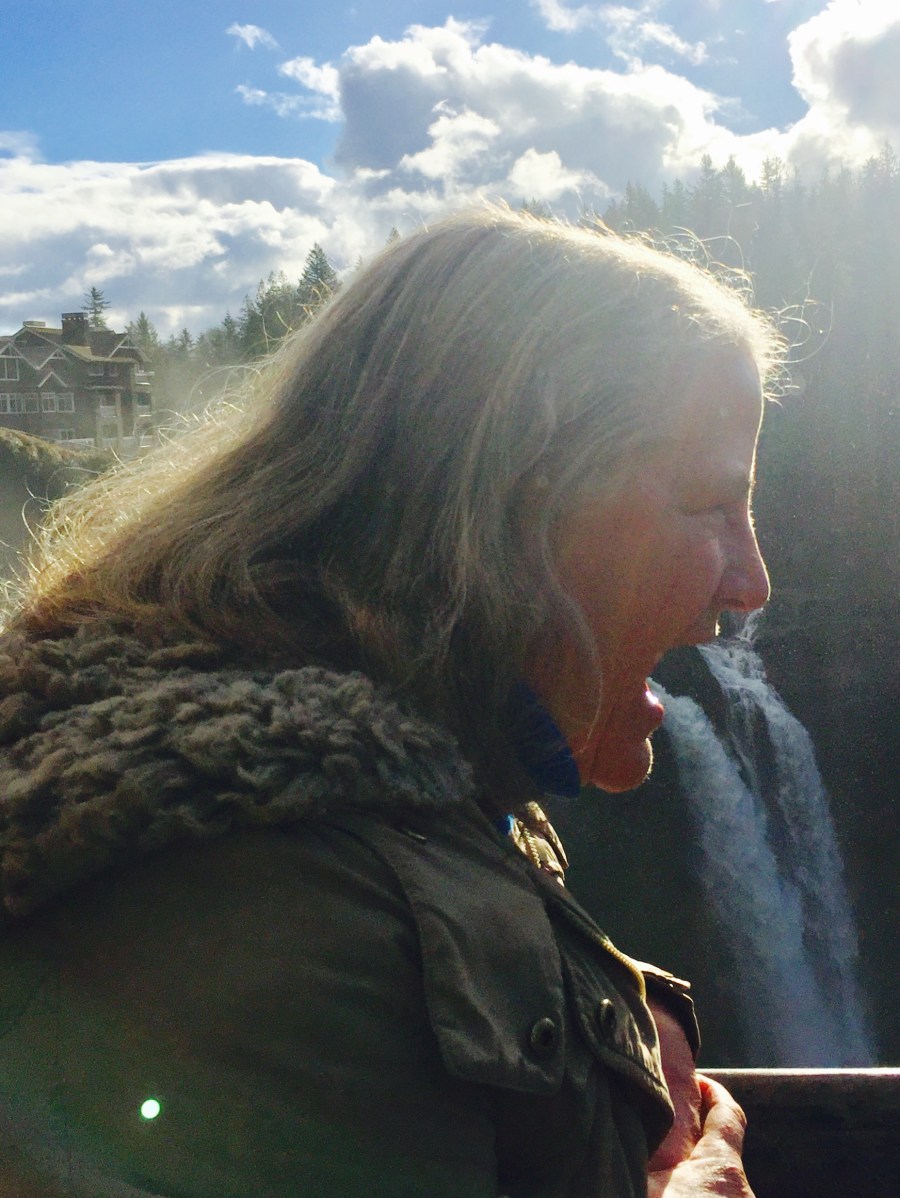
This particular month included two periods of unexpected overnight guests plus lots of homework and parties as the school/church year cycles to a close. Yes, there is always a wonderful built-in degree of frivolity and joyfulness, but I started this May with a doozy of a cold (see photo). Rob had another gout flare-up. And several of our friends are sick too; some hospitalized. It’s been quite the ride for all of us.

Still, remember when I promised myself I’d post once a month?

I’ve decided the best approach is to record the highlights that set me to giggling:

  • First, Murder for Two. Our favorite Seattle theater, The Fifth Avenue, added this musical to the season, recognizing that given the political course of events, we’d need some comedy. Sadly, the show got lukewarm reviews. At the same time my friend, Ruben, a long-standing, exemplary and recently-retired high school drama teacher, learned as he neared 65 and Medicare-eligibility, that his immigration status was being questioned. Because he always laughs loudly at the least provocation after the curtain rises, I decided in his honor, that I would laugh as often as possible during Mf2. Surprise, surprise. I earned myself several deep belly guffaws. Plus I flew to my feet at the end of the show joining my theater-going friends in a standing ovation. Ah, Laughter. Reviews be damned!
  • Later I stretched a lunch break – something I really have no business doing, especially at this time of year. I went to the hospital to visit my friend and her husband who’d had a stroke. You know how it is with dear friends. As hard as the situation may be we got around to quietly chortling together. We were spurred on by reading Billy Collin’s poems aloud from my phone—gems like Forgetfulness (we could all relate) and The Lanyard (since Mother’s Day had passed, we decided to dub May “Mother’s Month.”) When I got home, I found my favorite of his: Another Reason Why I Don’t Keep a Gun in the House. That story never fails to cheer me.
  • Finally I heard my friend and colleague Betty talk about her career as a counselor in a high-poverty elementary school. Thank God, she has it, because she told us some sad stories. Again, the comic relief helped. So did her understanding about interventions and resilience. Since this presentation was designed as a send-off into retirement for Betty and her husband John, I was responsible for bringing the festive cake. It was decorated with two photos I’d furtively swiped from Facebook—a cute one of John and Betty as college co-eds when they first met thirty-some years ago and a classy one from their daughter’s recent wedding. I must admit I was proud of myself, yessirree; that cake would be a great centerpiece. As I showed off the goods to my social-committee buddies pre-party I suffered a moment of panic when one of them asked, “What if this person from the past is an old flame and not her John?” Sure enough, that guy from long ago is Betty’s brother. What a way to blemish a retirement gig?! Then again, Betty’s a comedian and has assured me, “Our family will retell this story for years with great hilarity.”

Ok, ok—you probably had to be there. Long and the short of it is, might as well laugh. It helps.


Problems in Privileged Paradise

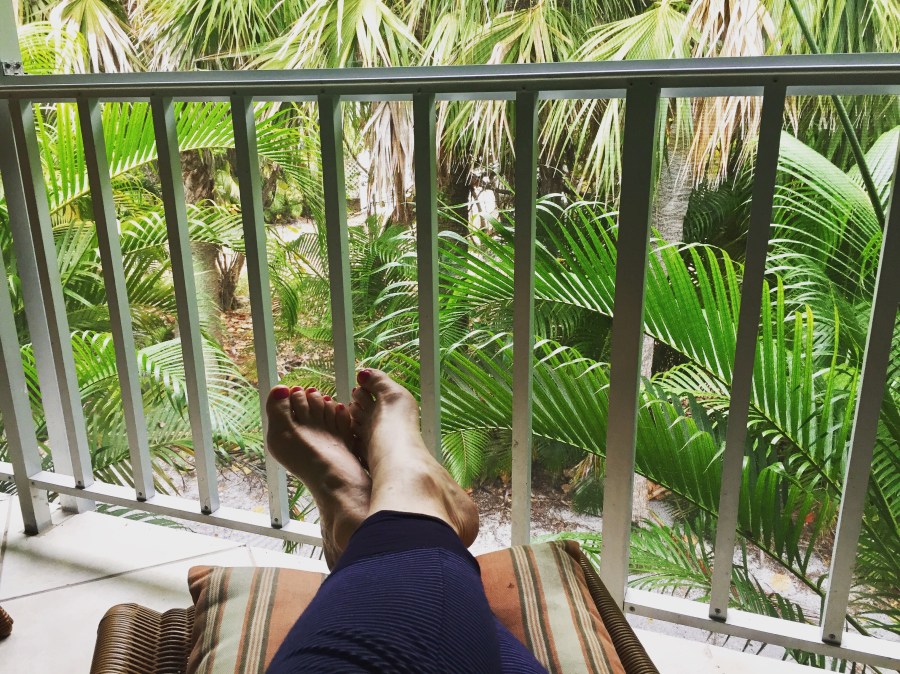
Palm porch.JPG

During this quiet spring break I have noticed a deepening internal calm. On our first morning in Southwest Florida, I was sheltered on our condo’s screened porch set high in the palms for the only downpour. All I could do was laugh out loud. The storm swept any humidity and bugs away and we were treated to what locals call a cold event. We settled quickly into the exquisitely pleasant air—sunny, 70’s, with a steady breeze. For us sodden Northwesterners, this was complete comfort.

Even though it’s Holy Week I decided not to pack my Bible or prayer book. Instead I finished the weekly EfM homework before leaving Seattle and checked the upcoming assignments. While on vacation, I found Gideon’s version of the Bible in the nightstands at both lodging sites so was able to read Proverbs and Ecclesiastes. I like the descriptions of wisdom and notice (with pride), it’s budding in me. Also read a novel cover-to-cover. And added regular PT exercises and meditation. Hummed metta verses. I appreciated Rob too–his driving prowess, dry sense of humor, keen eye for wild birds and creatures, his touch. Near bliss.

One evening of this luscious vacation, we were wand-searched by the secret service for the first time in our lives. Silly us, we thought our 34th wedding anniversary was causing the stir. No, we were dining alongside Vice President Mike Pence. When he left the vicinity, he took the time to shake hands with every youngster in his path while all the adults snapped photos. I was surprised to find myself warming to him and wondering, “Is it calm that creates this miraculous fondness?” I was even more amazed this morning when I saw a photo of Orange 45’s white soiled golf slacks. First time I’ve deleted a Facebook post. Who circulates gastric accidents like that one? Who knew I could conjure up honest empathy for this person too? Even with no agreement on policy, I felt sad, appalled even. I’m an old-enough extroverted glutton myself. I know that could happen to me too, for God’s sake, wise or not.

Slapped me right back to this pitiful human being that is me.  So much for piety. Here’s a better example: the second night in our condo, no A-C was needed. Instead we opened the windows and slider to invite cross-ventilation of the graceful outdoor air. Alas, someone next door was smoking! The nerve. I was pissed. How dare they?! On these no-smoking grounds even! I couldn’t see the culprits but boy did I conjure up overweight red-necked monsters in my mind. All my stereotypes converged. That night we chose to close the slider but I found myself repeatedly imagining what I’d say the next morning to cut that dang smoker off, “Could y’all please refrain from smoking at least while we’re out here?” Would that be direct enough to make them behave and nice enough to not open fire? I wouldn’t even have to look at them, just speak around the opaque barrier between our porches.

Scorpio ire flared again today when we boarded our plane. Rob and I have an elaborate scheme when we travel as a two-some. He’ll take the middle seat if there’s a woman at the window while I get the aisle (and vice versa if there’s a man on the outside.) Instead a late-70-something elderly woman was already plopped right next to the aisle when we got there. She was as nice as she could be, calling us honeys and everything but don’t-you-know couldn’t produce a boarding pass to prove her seat assignment (like I could). Jeez, I was irritated! No fun being stuck beside the window to journey across the country. I don’t care how old she is. Grrr! Best just to go pee and see if peaceful Rob Reid could straighten things out before I returned.

I was definitely brought back to size and sheer baseness—so much for calm peace—as  I thought of my favorite video clip of the week. Hadn’t I remembered anything? Ruth Bader Ginsburg advised me not to fret. Absolute worthless time suck. And what’s more, to turn a deaf ear to ugly statements especially the ones in my mind. After all if I react out loud and in kind, it will be difficult to persuade later. I have a lot to learn on both counts.

Here’s what happened though when I did manage to bite my tongue and cool down:

The morning-after, reading out on the porch in the crisp sweet air, Rob joined me a few minutes before we heard the neighboring slider open. Simultaneously, Rob coughed and I mumbled without thinking, “Ah, fresh air will help.” Who knows if that really was the clear discouragement our smoker needed but next we heard someone leaving. Was that a door slamming? Almost too easy.

And what about when I returned to my seat on the plane? No resolution at first but as I began to climb in Rob noticed three empty rows of seats–18 of them altogether!!–in the back of the coach section. Does this really happen anymore? With a nod from the flight attendant, we grabbed our backpacks and pranced back as the doors were closing.

Later in the flight, I returned to check in with the matron, clearing my own conscience if nothing else. Now I’m just hoping being in the far back won’t jeopardize our chances for catching the second flight after a tight layover. But you can bet I am not wasting time worrying about it. Instead I’m spreading out and enjoying the trek home. Resurrecting a little bit of calm, mellow Florida as I go.


Books that Bridge

Dance Joy

Until recently I have only opened one book at a time. Well, when I was in college I suffered through several texts at once. Then there was a long stretch of my life when I enjoyed a novel interspersed with a chapter or two of non-fiction. Now, with no kids, animals or visitors in the house, I have the luxury of reading several books at a time. I’m still working full-time though so I find myself only finishing a couple per month. I fantasize mightily about when I retire, and hop on a train with a stack of the print companions—no e-reader for me, thank you—while I travel across the country and back. Sounds like bliss.

For professional development this year I’m focused on Race and Equity. The material is definitely evocative; that’s an understatement. I’m glad that part of the HR requirement is to assemble a small group of colleagues to read together, discuss and apply our learning. We started with Between the World and Me by Ta-Nehisi Coates. So far in 2017, I’ve finished The New Jim Crow: Mass Incarceration in the Age of Colorblindness by Michelle Alexander and Hunger of Memory, The Education of Richard Rodriguez, An Autobiography. Waterlily, a novel about the Dakota people by Ella Cara Deloria and Negroland, the new memoir by Margo Jefferson are on my nightstand now, both half-digested.

I’ve also read several books of The Hebrew Bible as part of Education for Ministry (EfM), Year One. EfM is a four-year course developed by University of the South School of Theology in Sewanee,Tennessee. Each week I meet with 11 others to discuss these ancient scriptures and the commentary. I find myself more and more fond of my co-readers half of whom are men and half women; half younger/half older; some gay some straight; and one native Spanish speaker. I think we’d all call ourselves Christians but I’m not sure about that. We Episcopalians welcome diversity of all kinds, including differing beliefs so this hasn’t been an issue. As my son said about another group at the cathedral, “This is the most diverse group of white people I’ve ever met.”

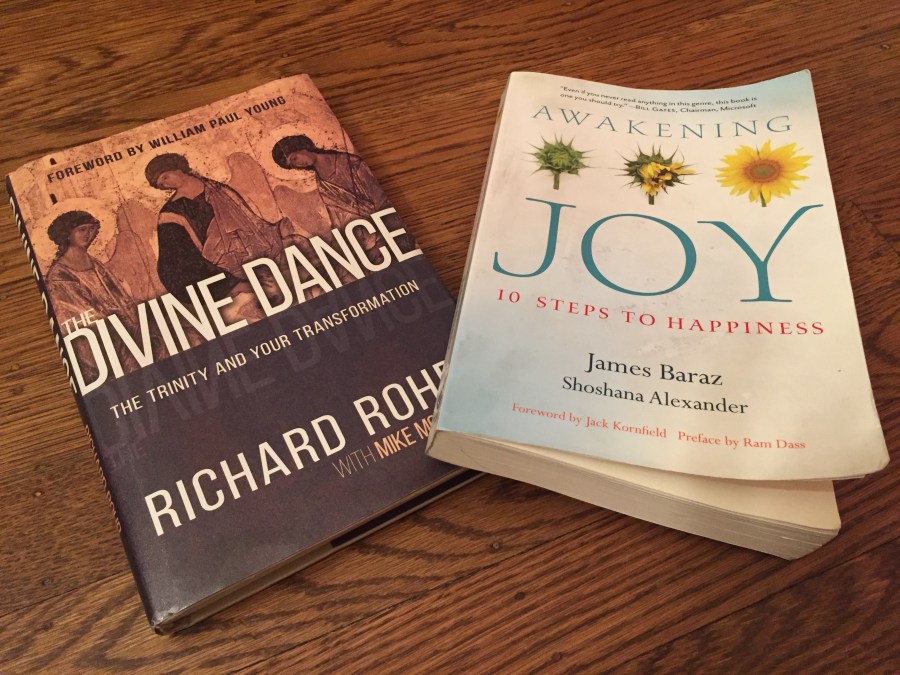
But the best current combination of books has been my morning practice jewels: The Divine Dance, The Trinity and Your Transformation by Richard Rohr and Mike Morrell and Awakening Joy, 10 Steps to Happiness by James Baraz and Shoshona Alexander. Most mornings for the past ten weeks I’ve read several sections of each book. Dance was an easy choice because I really appreciate Franciscan Rohr’s perspective on theology. This is his latest about the pervasive relationship of Trinity. My friend Jeanne introduced me to Joy, a Buddhist guide to becoming deeply content and embracing well-being. Both books are laced with real life stories. Both reference literature as well as spiritual leaders from around the globe and across time. With its frequent footnotes, Dance is slightly more academic and theoretical while Joy offers practical how-to advice.

Remarkably, as I absorb these works simultaneously I find no more room for the religion compartments I’ve heretofore established in my mind. When I think back, I can’t remember which pearl of wisdom came from which book. The overall philosophies of Dance and Joy are that similar. James Finley said it this way, “When we seek what is truest in our own tradition we discover we are one with those who seek what is truest in their tradition.” Nurturing these blossoms in the rich fomenting soil of my equity and scripture readings takes me right over the top—practically orgasmic. I can hardly describe it in words but I know this is what I was born for and what I will die for eventually.


Huesos as Living Prayers

mr-body

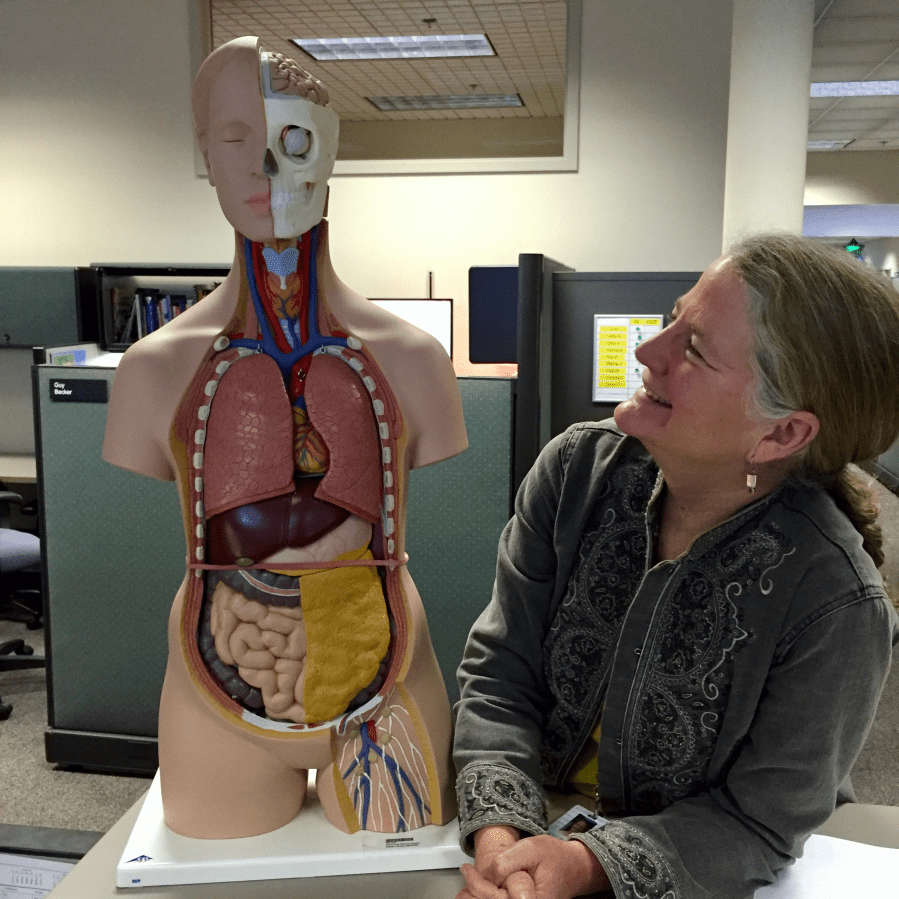
I stood for a full twenty minutes in a Nicaraguan cemetery under mi sombrilla and alongside my friend, Xiomara. She was trying to describe the meaning of the word huesos. Of course she knew the exact translation in English. In the interest of my language learning though, we had agreed to use only Spanish on our afternoon explorations around the mountain town of Matagalpa. Xiomara tried synonyms like esqueleto and marco del cuerpo and related words like piel, vasos and médula. She gestured and pointed to various parts of our bodies.

Under a clear celestial blue sky we stood, surrounded by long white boxes and grave markers.  Colorful plastic flowers and banners decorated the landscape. We’d made our way up a hill and found ourselves before a sturdy white shed. I understood Xiomara to say that the building was full of dry huesos. But I was confused. Since this was quite a different way to dispose of human remains than in my culture, it took me a long time to connect that huesos were….bones….and this particular casita was full of them.

When I finally understood the meaning I exclaimed, “Bones!” Joyfully, we grabbed each other and danced among the dead.

The next day my host family invited me to a small Evangelical church for mass. They knew I taught preschoolers so rather than subject me to the long adult service, they positioned me in class with the pastor’s son where he guided the youngest children. When he asked me to lead a game, I almost squealed with delight. Déjà vu! In that very moment, I remembered learning “Dog, dog, where’s your bone?” while in Sunday School 50 years ago. I could now translate this question and teach the little ones on the dirt floor in front of me, “Perro, perro, donde está tu hueso?” Don’t ask me how this related to the learning objectives for the day…perhaps about being joyful or the lost being found?

Bones, the solid frames we all share.

“Dem Bones,” the camp song my sisters and I led in a sing-along to end my father’s memorial service and transition to the reception.

Bones, the chips that can sometimes be identifiable in ashes after cremation. The same particles my priest Nancee warned me about when we prepared to take ashes home to Virginia. Apparently they scare some people.

Recently my study group at the cathedral read Ezekiel’s story about a valley full of dry bones. God tells Ezekiel to preach to the bones. When the breath comes into them, they rattle and gain sinew and skin. Then they stand on their feet again. They live. In the wake of this powerful prophecy, all of my stories about huesos and bones came tumbling back.

Because this is my experience with bones.

For a long time the best description of intercessory prayer I could muster was a paraphrase from Madeleine L’Engle. She said, “Every fond thought is a prayer.” This made sense to me.

Recently though these fond thoughts have become the bones. The more details I know about a situation – what a person needs, how he or she hurts…take for instance when my daughter called to say her dear surrogate grandmother had died…or when my friend emailed to say that while his kid had survived major surgery, she now suffered “world-class constipation”…or when yet another friend relayed that her son had caught her husband in a lie that exposed his long-time affair and could end their marriage – Yes, the more details I know the more flesh these prayer bones have and the more often the fond thoughts come.

For me this is when the dry bones breathe and live. They stand on their own feet. Spirit is in them and they are placed upright on the earth as well as in the rich soil of my heart. I can hold them there and help assuage the suffering. When I hear my daughter’s tears or recognize the specific bodily discomfort or know the names of the children who will flail and sob as their parents’ marriage crumbles, then I can put flesh on dem huesos and weep too. The valley doesn’t seem so desolate anymore, nor as lonely. Instead even in pain and loss, life and breath and spirit wait. The bones will first rattle and then live, even sing and dance again.

It seems incredulous really that something so very basic as bones – huesos – especially dry dead ones could be stacked in a hut on the side of a hill in Matagalpa and could be the centerpiece of a children’s game stored in my memory for half a century. They also can live as breath courses through them again and can represent prayer in all its fullness and hope. In this way, they become metaphors. I recognize myself as poet, feebly describing the delicate difference between life and death again – basically and finally not very distant from each other at all.