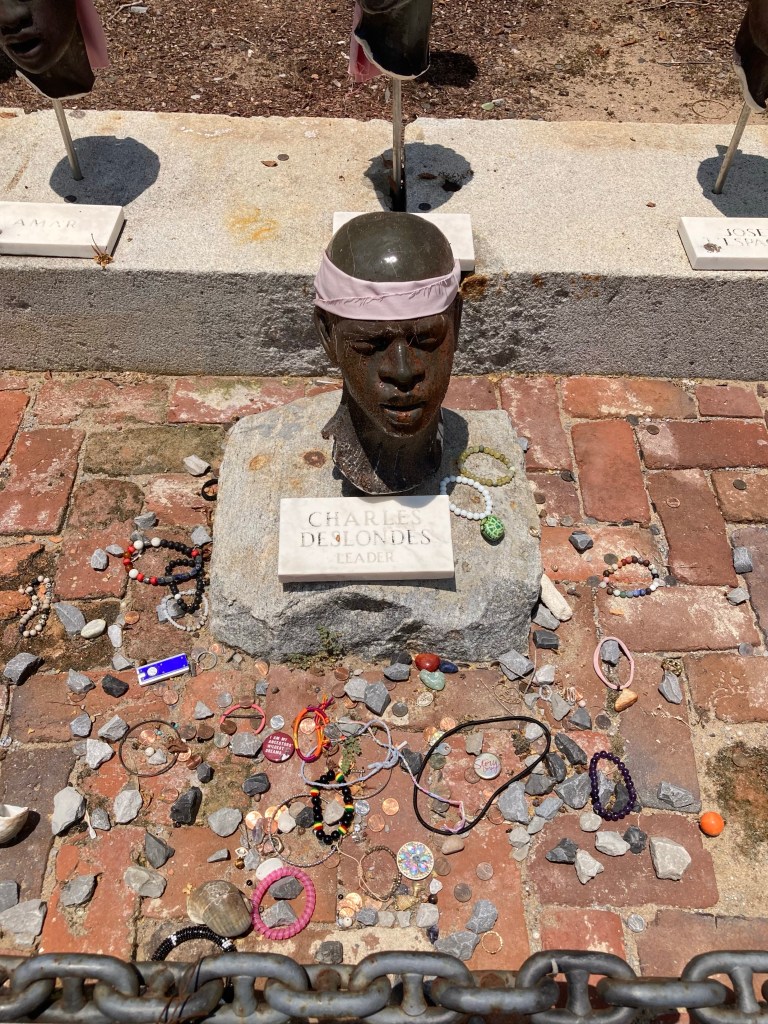
On Friday, eight of us detoured away from the convention to tour plantations. At first, I was hesitant given the haunted grounds where such violence happened against enslaved people. But I like that the group chose to visit Laura, a Creole plantation, as well as Whitney, one converted and dedicated to telling the story of Blacks who suffered there and in the larger state of Louisiana. I sought education.
At Laura, I learned that Creoles share the traits of 1) being Roman Catholic, 2) speaking French and 3) being born on U.S. soil. They are, by definition, a mixed race. I noticed that while there was some crossover, the light-skinned people tended to be the owners and the dark-skinned people tended to be enslaved.
The guide did not gloss over the cruelty that ensued. A Black woman shed tears as she tried to ask a question when we visited the slave quarters. I was too stunned, afraid of the feelings I might unleash if I breathed deeply or spoke aloud.
While I was physically miserable, I’m glad we toured Whitney midday, outdoors in humid, high-90-degree heat. The impact was grueling as we traipsed through the exquisite artwork listening to ex-slaves relay their memories through our individual audiophones. It was hard to imagine how humans could possibly survive from sunup to sundown working in those sizzling sugarcane fields.
When I finally reached the cool chapel, the last stop on the self-guided tour, I wept too.
Afterwards, a friend shared an article in which New York Times ethicist, Kwame Anthony Applan (on 12/28/2021), advised a guest who was invited to a wedding on plantation grounds to decline and explain why.
I knew I must write. Maybe I am on a high horse here, self-righteous even. But in Martin Luther King, Jr.’s words regarding silent complicity, “In the end, we will not remember the words of our enemies, but the silence of our friends.”
I can no longer witness racism, historical or otherwise, and condone it in silence.

 Always Bridging